 Specs
Best USB-C chargers for a laptop, phone and earbuds
Short answer: for most people charging a laptop, a phone and earbuds from one socket, the best charger in our October 2026 cluster is the UGREEN Nexode 100W 4-port, because it has four ports, publishes the exact watts each port gets, lists PPS for Samsung phones, and cost $39.99 on sale. The Anker Prime 100W is the pick for a single power-hungry laptop and a light bag. Both are graded from the makers' spec sheets and warranty terms, checked October 17, 2026; see How we picked.
Our picks
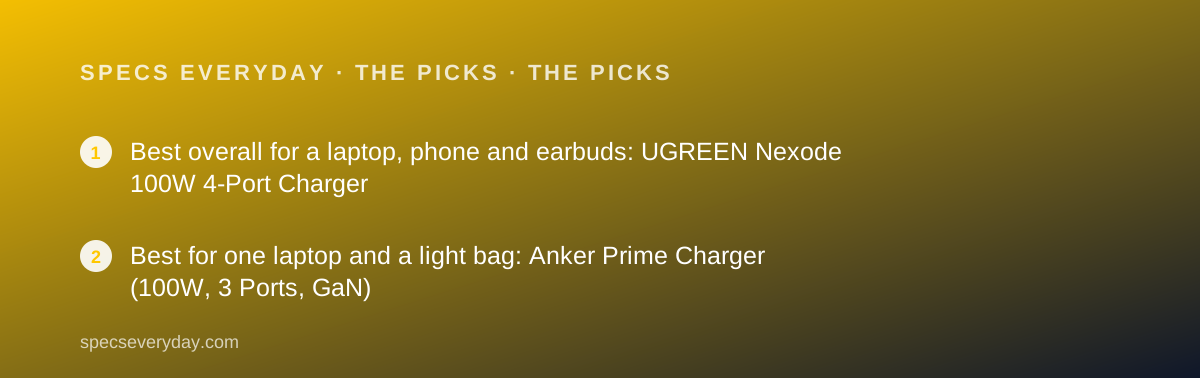
- Best overall for a laptop, phone and earbuds: UGREEN Nexode 100W 4-Port Charger
- Best for one laptop and a light bag: Anker Prime Charger (100W, 3 Ports, GaN)
The best USB-C chargers at a glance
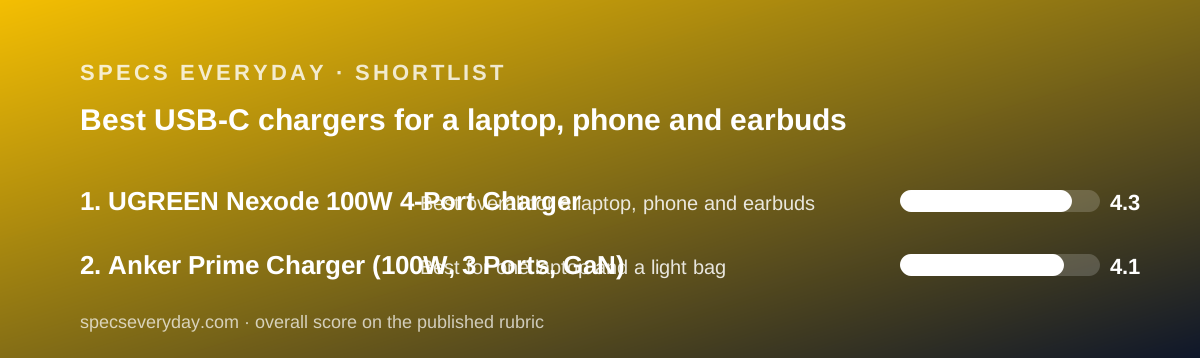
Two 100 W chargers, graded from their makers' spec sheets and store pages on October 17, 2026. The links go to our full reviews and the head-to-head.
- UGREEN Nexode 100W 4-port - best overall: four ports, every split published, PPS listed, $39.99 on sale.
- Anker Prime 100W - best for one laptop and a light bag: 100 W two-port total, 170 g, 24-month warranty, $69.99.
Scores out of 5 on our rubric: UGREEN 4.3, Anker 4.1. Deciding between them? Read Anker Prime 100W vs UGREEN Nexode 100W.
Who this guide is for
This guide is for people who want one wall charger for the three devices most people carry: a laptop, a phone and a pair of earbuds or headphones. It is for a bag, a bedside or a hotel room, where one socket has to do everything.
It is not for 16-inch MacBook Pro owners who want Apple's fast-charge rate, which needs 140 W, and it is not for a desk that already has a USB-C monitor charging the laptop. For that desk, see our office monitor guide.
How we picked
We did not run tests of our own; grades come from documentation, pricing pages and verified user reports checked on October 17, 2026. We read each charger's US product page, spec table and charging images, plus Anker's and UGREEN's US warranty terms.
The laptop's share with other devices attached carried the most weight. A charger that gives a laptop 100 W alone and 45 W with two phones attached is a different product from one that holds 65 W. We scored what the maker publishes, and marked down a maker that publishes only totals.
Published detail counted as a feature. A per-port table lets a buyer decide before purchase. A missing table forces a guess, so it cost points on both features and ease of use.
Protocols mattered for phones. Samsung's 45 W Super Fast Charging 2.0 uses PPS, per Samsung's own adapter page, and Apple lists specific wattages for each iPhone. A charger had to name its protocols to score well for phones.
Warranty counted under support. Both picks carry two years; a one-year charger would have needed a much lower price to rank.
What each device actually needs
The right charger depends on what you plug in. These are the makers' own figures, checked October 17, 2026.
- MacBook Air (2022 or later): Apple lists 30 W (13-inch), 35 W dual-port, 67 W and 70 W adapters, and fast charging with 67 W (13.6-inch only), 70 W, 96 W or 140 W.
- 14-inch MacBook Pro (2021 or later): Apple lists 67 W, 70 W and 96 W adapters, and fast charging only with 96 W or 140 W.
- 16-inch MacBook Pro (2021 or later): Apple lists only the 140 W adapter.
- iPhone 17, 17 Pro, 17 Pro Max: up to 50% in about 20 minutes with a 40 W or higher adapter.
- iPhone 18 Pro, 18 Pro Max: up to 50% in about 15 minutes; third-party adapters must be 60 W-capable with USB-PD 3.2 and Adjustable Voltage Supply.
- Samsung Galaxy S25+ and S25 Ultra: Samsung lists them for 45 W Super Fast Charging 2.0, which its adapter delivers through PPS.
- Earbuds and headphones: a few watts. The Sennheiser MOMENTUM 4 Wireless lists USB-C charging at 5 V and 800 mA, about 4 W.
The pattern: the laptop decides the charger, the phone decides the protocol, and the earbuds decide nothing. Any port on either pick covers earbuds.
Best overall: UGREEN Nexode 100W 4-port
The UGREEN is the only charger here that charges a laptop, a phone, earbuds and a watch together, and it tells you what each gets. Its charging guide shows 65 W and 30 W for a laptop and a phone, 45 W, 30 W and 22.5 W with earbuds added, and 45 W, 30 W, 10.5 W and 10.5 W with a watch too.
For a MacBook Air, 65 W sits inside Apple's listed adapter range of 30 W to 70 W. Apple's fast-charge list starts at 67 W, so with a phone attached the Air charges just below the fast rate. For a 65 W Windows laptop, it is the laptop's own adapter wattage.
For phones, it lists PPS, so it is the safer choice for a recent Galaxy. An iPhone 17 next to a laptop gets 30 W, below Apple's 40 W line for the 20-minute half charge; alone on the first port it gets up to 100 W.
Its earbud ports are the third USB-C and the USB-A, at 22.5 W alone or 10.5 W when shared. Earbud cases such as the AirPods Pro 3 and Samsung Galaxy Buds4 Pro are in the few-watt range.
Limits: a laptop never gets 100 W with a second device attached, UGREEN's FAQ caps Dell laptops at 65 W, and the page contradicts itself on port count and weight. Read the full UGREEN Nexode 100W review.
Best for one laptop and a light bag: Anker Prime 100W
The Anker keeps a 100 W total with two devices attached, which on paper means more power to a laptop while a phone charges. Anker tells owners to put the laptop on the top USB-C port, but does not publish the split.
It is the lighter charger by any reading of the two pages: 170 g against 210 g or 313 g for the UGREEN, depending on which UGREEN table you trust. For a 14-inch MacBook Pro owner who wants to stay near Apple's 96 W fast-charge line with a phone attached, it is the better bet, with the caveat that the split is unstated.
Its page names no protocols, so it gives no basis to promise Samsung's 45 W mode. iPhones on the iPhone 17 line will see their 40 W requirement met by either USB-C port alone.
Limits: three ports, a $69.99 price, no cable, and no published split. Read the full Anker Prime 100W review.
Also compared, and why they did not make the cut
Four other chargers from the same two makers were on their US stores on October 17, 2026. None fits the brief of one laptop, one phone and one pair of earbuds as well as the two picks.
- Anker Prime Charger (160W, 3 Ports, Smart Display) - $149.99, on sale at $115.99. The route for a 16-inch MacBook Pro, at roughly three times the UGREEN's price.
- Anker Prime Charger (250W, 6 Ports, GaNPrime) - $149.99. A desk power station rather than a bag charger.
- UGREEN 100W Desktop Charger - $79.99, four USB-C and two USB-A ports in a desktop body, for the same 100 W total as the Nexode 4-port.
- UGREEN Nexode 65W 3-Port Charger - $27.99 on sale, $39.99 regular. 65 W for the whole charger means the laptop shares 65 W with everything else.
Anker Prime Charger (160W, 3 Ports, Smart Display). Anker's US store listed it at $149.99, on sale for $115.99, on October 17, 2026. It did not make the cut because it costs roughly three times the UGREEN for the same three-device job; it is the Anker to look at for a 16-inch MacBook Pro, which Apple says fast-charges only at 140 W.
Anker Prime Charger (250W, 6 Ports, GaNPrime). Listed at $149.99 on Anker's US store on October 17, 2026. Six ports and 250 W is a desk power station, not a bag charger; it is outside the brief of one laptop, one phone and one pair of earbuds.
UGREEN 100W Desktop Charger. UGREEN's comparison table listed it at $79.99 on October 17, 2026, with four USB-C and two USB-A ports. It did not make the cut because it is a desktop unit at twice the price of the Nexode 100W 4-port for the same 100 W total.
UGREEN Nexode 65W 3-Port Charger. UGREEN's US store listed it at $27.99 on sale against $39.99 on October 17, 2026, with two USB-C ports and one USB-A. It did not make the cut because 65 W is the whole charger's limit, so a laptop shares 65 W with the phone and earbuds.
Who should spend more
Two groups should look above 100 W. Owners of a 16-inch MacBook Pro, because Apple lists only its 140 W adapter for that model and fast charging needs 140 W. And anyone charging two laptops at once at full speed, because neither pick gives two laptops more than a shared 100 W.
Everyone else, which is most people with a MacBook Air, a 14-inch laptop or a 65 W Windows machine, is well served by 100 W. Spending more buys headroom you will rarely use.
How to choose a USB-C charger
Start with the laptop's own adapter wattage. It is printed on the adapter, and on a Mac it appears in System Information under AC Charger Information, per Apple. Your new charger's laptop port should match it with your other devices attached, not just alone.
Read the multi-port table, not the headline. 100 W on the box is the single-port maximum. The number that matters is what the laptop port gives when the phone is plugged in too. If the maker does not publish it, treat that as a cost.
Check the phone's protocol. Samsung's fastest mode uses PPS. The iPhone 18 Pro's fastest mode asks for USB-PD 3.2 with Adjustable Voltage Supply. If a charger page does not name them, assume the phone charges at a standard rate.
Buy the right cable. 100 W is 20 V at 5 A, and only a 5 A cable with an E-Marker chip carries it. A 3 A cable caps the port at 60 W. Neither pick includes a cable.
Count your ports honestly. A watch charger, earbuds and a phone are three cables before the laptop. If that is your nightly routine, a four-port charger avoids unplugging something every night.
What the wattage on the box means
USB Power Delivery works by offering a menu of fixed voltages. Both picks list 5 V, 9 V, 15 V and 20 V on their USB-C ports, and the device picks one. A phone usually takes 9 V; a laptop takes 20 V.
Until 2021 the ceiling was 100 W: 20 V at 5 A. The USB Promoter Group announced USB PD Revision 3.1 on May 26, 2021, adding 28 V, 36 V and 48 V steps for 140 W, 180 W and 240 W, per its announcement. Neither pick uses those higher steps, which is why both stop at 100 W.
The 2021 revision also added an adjustable voltage mode from 15 V up to the top fixed voltage in 100 mV steps. That is the Adjustable Voltage Supply Apple now asks for on the iPhone 18 Pro. PPS, from the 2018 USB-IF fast-charger programme, is the older fine-step mode Samsung uses.
Travel: voltage, plugs and cables
Both chargers list 100-240 V input at 50-60 Hz, which covers mains power in most countries without a converter. Both US models have US prongs, so a plug adapter is still needed abroad.
Pack one 5 A USB-C to USB-C cable for the laptop and use the phone's own cable for the rest. Earbud cases and watches can share the small ports on either charger.
Common mistakes when buying a multi-port charger
- Reading 100 W as what each port gets; it is usually the total or the single-port maximum
- Using a 3 A cable and wondering why the laptop shows a slow-charge warning; 3 A caps the port at 60 W
- Plugging the laptop into a small port; on the UGREEN, the third USB-C port tops out at 22.5 W
- Assuming a phone fast-charges because the charger is fast; the protocol has to match
- Buying a charger for a 16-inch MacBook Pro below 140 W and expecting Apple's fast rate
When a monitor is the better charger
At a desk, a USB-C monitor can charge a laptop over the same cable that carries video. The BenQ PD2706U and the LG 27UP850K-W list 90 W, and the Apple Studio Display lists 96 W, per our reviews. That frees the wall charger for the bag, which tilts the choice toward the lighter Anker.
Pairing the charger with earbuds and headphones
The earbuds we graded all charge from a few watts, so the small ports on either charger are enough. Our commuting earbuds guide ranks four pairs, and our noise-cancelling headphones guide covers over-ear models, including the Sony WH-1000XM6, whose quick charge asks for a USB-PD adapter, which both picks are.
Bottom line
Buy the UGREEN Nexode 100W 4-port if you charge three or four devices from one socket, own a Samsung phone, or simply want the lower price. Buy the Anker Prime 100W if one laptop's charging speed and a light bag matter more than a fourth port. Either way, buy a 5 A USB-C cable with it.
Last checked and what changed
Last checked October 17, 2026. First published with two picks and four chargers compared. Prices were read from each maker's US store that day and change often; the port splits and warranty terms change rarely.
Best overall for a laptop, phone and earbuds: UGREEN Nexode 100W 4-Port Charger
The UGREEN Nexode 100W 4-Port Charger has three USB-C ports and one USB-A port, listed at $39.99 on sale against $54.99 regular on UGREEN's US store on October 17, 2026. Either of the first two USB-C ports gives 100 W alone. With a laptop and a phone it splits 65 W and 30 W; with earbuds added, 45 W, 30 W and 22.5 W; with all four ports busy, 45 W, 30 W, 10.5 W and 10.5 W. The spec table lists PD 3.0, QC 4+ and PPS on the USB-C ports, 100-240 V input and standby draw of 0.3 W or less, and the store states a minimum 2-year warranty. The weak points are the 65 W laptop cap with a second device attached and a product page that contradicts itself on port count and weight.
It sits at #1 because it is the only charger here that handles all three devices plus a watch from one socket, tells you in advance what each gets, and costs $30 less than the Anker on sale.
Visit UGREEN Nexode 100W 4-Port Charger
We have no affiliate relationship with this vendor. Link goes to the official site.
Best for one laptop and a light bag: Anker Prime Charger (100W, 3 Ports, GaN)
The Anker Prime Charger (100W, 3 Ports, GaN), model A2688, has two USB-C ports and one USB-A port, listed at $69.99 on Anker's US store on October 17, 2026. Either USB-C port gives 100 W alone, two ports in use total 100 W, and three total 89 W; the USB-A port tops out at 22.5 W. It measures 43.5 x 29 x 67.8 mm and weighs 170 g, and Anker's US warranty table lists 24 months for Prime chargers. Anker does not publish how the 100 W or 89 W divides between ports, and its page names no charging protocols, including PPS.
It sits at #2 because it keeps a 100 W two-port total and is the lightest charger here, but it has one fewer port, does not publish its split and costs $30 more on the day we checked.
Visit Anker Prime Charger (100W, 3 Ports, GaN)
We have no affiliate relationship with this vendor. Link goes to the official site.
How we chose
We did not run tests of our own; grades come from documentation, pricing pages and verified user reports checked on October 17, 2026. Specifically, we read each charger's US product page, spec table and charging images, each maker's US warranty terms, Apple's and Samsung's published charging requirements, and the USB-IF specification announcements. A charger had to deliver at least 100 W from one USB-C port, carry at least three ports and be sold on the maker's own US store.
Frequently asked
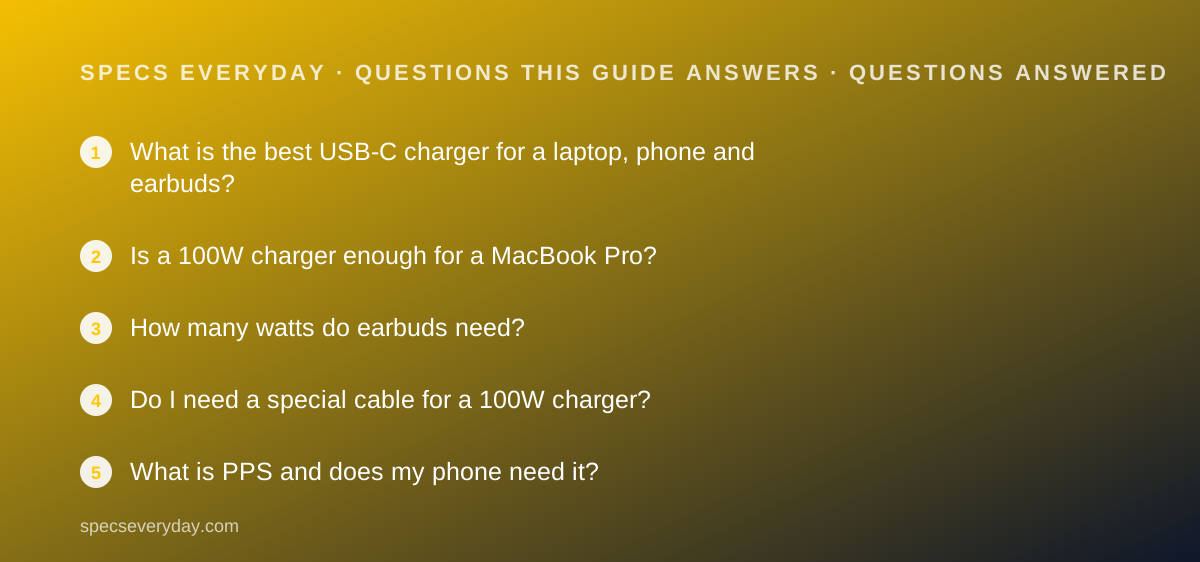
What is the best USB-C charger for a laptop, phone and earbuds?
In our October 17, 2026 grading, the UGREEN Nexode 100W 4-port: four ports, a published split of 65 W and 30 W for a laptop and phone, PPS listed, and $39.99 on sale. The Anker Prime 100W is better for one laptop that must keep near 100 W with a phone attached.
Is a 100W charger enough for a MacBook Pro?
For the 14-inch MacBook Pro, yes on wattage: Apple lists fast charging with 96 W or 140 W adapters, and 100 W alone clears 96 W. For the 16-inch model, Apple lists only the 140 W adapter, so a 100 W charger works but below the fast-charge rate.
How many watts do earbuds need?
Very few. The Sennheiser MOMENTUM 4 Wireless headphones list 5 V at 800 mA, about 4 W, and earbud cases are in the same range. A 10.5 W or 22.5 W small port on either charger covers them.
Do I need a special cable for a 100W charger?
Yes. 100 W is 20 V at 5 A, which needs a USB-C cable rated for 5 A with an E-Marker chip. A common 3 A cable caps the port at 60 W. Neither charger in this guide includes a cable.
What is PPS and does my phone need it?
PPS, Programmable Power Supply, is a USB Power Delivery 3.0 feature that lets a phone request voltage in fine steps. Samsung's 45 W Super Fast Charging 2.0 uses it, per Samsung's adapter page. iPhones do not need it; Apple lists wattage and, for the iPhone 18 Pro, Adjustable Voltage Supply.
Is it safe to charge earbuds on a 100W charger?
Yes. USB Power Delivery chargers offer a set of voltages and the device requests what it can take, so earbuds draw a few watts at 5 V. Both makers list overcurrent or temperature protections on their pages.
Sources
- UGREEN Nexode 100W 4-Port Charger product page, spec table and charging guide (US store) - checked October 17, 2026
- Anker Prime Charger (100W, 3 Ports, GaN) A2688 product page and spec table - checked October 17, 2026
- Anker US warranty table (refund policy page) - checked October 17, 2026
- Apple Support: Use a power adapter with your Mac - checked October 17, 2026
- Apple Support: Fast charge your MacBook Air or MacBook Pro - checked October 17, 2026
- Apple Support: Fast charge your iPhone - checked October 17, 2026
- Samsung 45W Super Fast Charger 2.0 (EP-T4511) product page, UK - checked October 17, 2026
- USB-IF: Certified USB Fast Charger and PPS announcement, January 8, 2018 - checked October 17, 2026