 Specs

Sony WH-1000XM6
Sony's flagship noise-cancelling headphones read from the spec sheet: 30 hours with ANC, Bluetooth 5.3, LDAC and LC3, 12 microphones, folding earcups
Scored on the published rubric, from documentation, pricing and verified user reports.
Best for: Commuters and frequent flyers who want the longest feature list in the premium bracket and own an Android phone that can use LDAC
Verdict
The Sony WH-1000XM6 is the most completely specified premium noise-cancelling headphone on sale in October 2026, and the spec sheet backs that up line by line. Sony lists up to 30 hours of music with noise cancelling on and 40 hours with it off, a 3-minute quick charge worth up to 3 hours, Bluetooth 5.3 with SBC, AAC, LDAC and LC3, multipoint, 12 microphones and folding earcups, all at $459.99. This is a documentation review: every figure comes from Sony's US store page and support specification page, read October 16, 2026, not from use. The gaps are also on the record. The quick charge needs an optional USB-PD adapter, the weight is 8.96 oz, which is lighter than Apple but heavier than Bose, and the warranty length did not render on the page we read. If you want one pair that does everything and you use Android, this is the default pick. If you mainly want the lightest cups or the longest battery, other models beat it on those single lines.
Visit Sony WH-1000XM6
We have no affiliate relationship with this vendor. Link goes to the official site.
Where it is strong
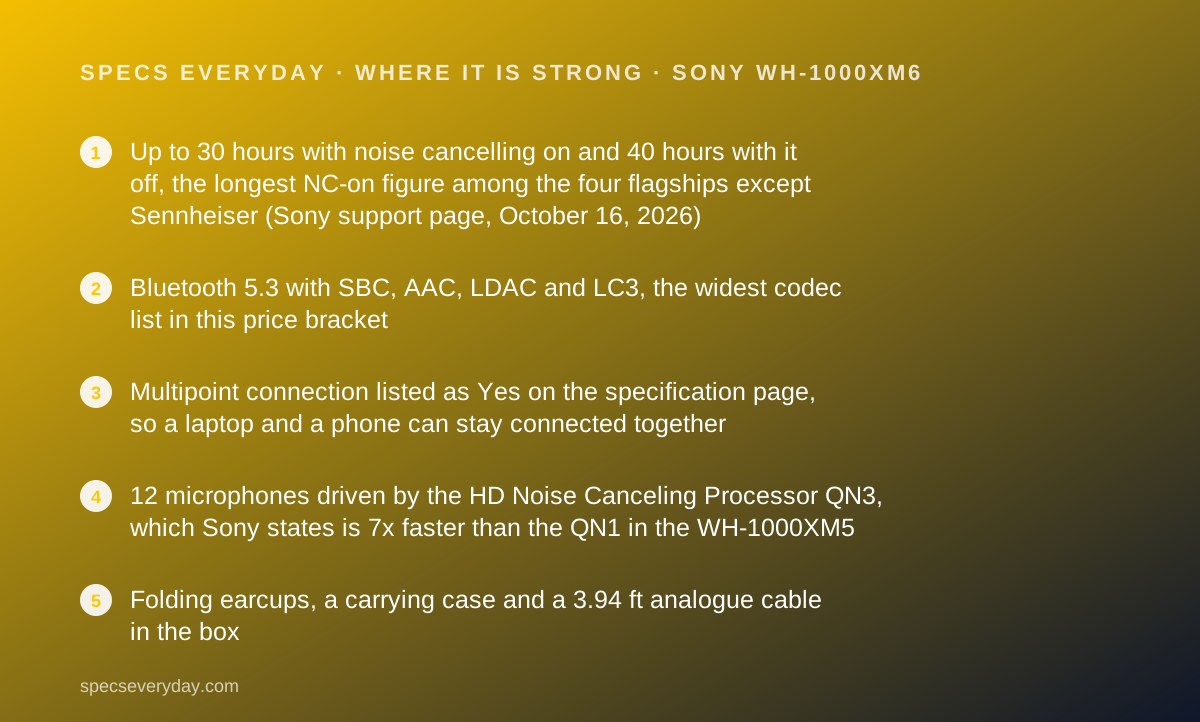
- Up to 30 hours with noise cancelling on and 40 hours with it off, the longest NC-on figure among the four flagships except Sennheiser (Sony support page, October 16, 2026)
- Bluetooth 5.3 with SBC, AAC, LDAC and LC3, the widest codec list in this price bracket
- Multipoint connection listed as Yes on the specification page, so a laptop and a phone can stay connected together
- 12 microphones driven by the HD Noise Canceling Processor QN3, which Sony states is 7x faster than the QN1 in the WH-1000XM5
- Folding earcups, a carrying case and a 3.94 ft analogue cable in the box
- 3 minutes of charging for up to 3 hours of playback
Where it falls short
- The 3-minute quick charge requires an optional USB-PD adapter that Sony does not include, and the headphones must be switched off
- $459.99 is $10 above Bose and $160 above the Sennheiser list price for the same core job
- Approx. 8.96 oz, which our conversion puts near 254 g, heavier than the Bose QuietComfort Ultra Headphones
- Warranty duration did not render on the store page or the Sony support site when read on October 16, 2026; only a warranty card is listed in the box
- Full charge takes approx. 3.5 hours, the slowest of the four flagships we compared
At a glance
| List price | $459.99 (Sony US store, October 16, 2026) |
|---|---|
| Pricing note | $459.99 at the Sony US store for every colour (product page, checked October 16, 2026) |
| Battery, music | Max. 30 hrs NC on, max. 40 hrs NC off |
| Battery, calls | Max. 24 hrs NC on, max. 28 hrs NC off |
| Charging | Approx. 3.5 hrs full; 3 min for up to 3 hrs with optional USB-PD adapter |
| Bluetooth | Version 5.3, range approx. 32.81 ft |
| Codecs | SBC, AAC, LDAC, LC3 |
| Driver | 1.18 in (about 30 mm, editorial conversion), neodymium magnet |
| Weight | Approx. 8.96 oz (about 254 g, editorial conversion) |
| Multipoint | Yes |
| Microphones | 12 (for noise cancelling and calls) |
| Folding | Yes, folding earcups |
| Warranty | Duration not readable on the pages we rendered; warranty card in the box |
What the Sony WH-1000XM6 actually is
The WH-1000XM6 is Sony's current flagship closed-back, over-ear wireless headphone with active noise cancelling. It replaced the WH-1000XM5 and, per Sony's own store copy, brings back folding earcups that the XM5 dropped.
The product is built around one chip. Sony calls it the HD Noise Canceling Processor QN3 and states it runs 7x faster than the QN1 found in the XM5, driving 12 microphones for noise cancelling and calls.
Everything else on the sheet is conventional for the class: a 1.18 inch dynamic driver with a neodymium magnet, Bluetooth 5.3, a USB port for charging and a detachable single-sided analogue cable. Sony lists the frequency response as 4 to 40,000 Hz (JEITA).
This page is a documentation review. We read the Sony US store page and the Sony support specification page on October 16, 2026 and translated them. We did not use the headphones, and nothing here claims otherwise. Our method is explained on the how we read spec sheets page.
Who the Sony WH-1000XM6 is best for
The spec sheet points at a specific buyer: someone who wants every box ticked and is willing to pay the top of the market for it.
- Commuters on trains and buses who need noise cancelling that adapts to pressure and wearing style, which Sony's Adaptive NC Optimizer line describes
- Hybrid workers who move between a work laptop and a personal phone, because multipoint is listed as Yes
- Android owners who can use LDAC and want the higher bit rate Sony specifies at 990 kbps
- Frequent flyers who want a case that folds small and up to 30 hours with noise cancelling on
- Call-heavy users who want the 24 hour NC-on talk time Sony lists, the longest talk figure we found on any of the four flagship pages
- Buyers who keep headphones for years and want LC3 and LE Audio profiles already listed
Who should skip the WH-1000XM6
Three groups get less for their $459.99 than the headline suggests.
- iPhone-only users: Apple devices do not use LDAC, so the codec advantage over AAC disappears on an iPhone
- Anyone who will never buy a USB-PD adapter: the 3-minute quick charge headline depends on one
- Buyers who care about weight first: 8.96 oz is not heavy, but Bose lists a lower figure and Sennheiser's lighter-weight design is a stated selling point even though Sennheiser does not publish a gram figure
Battery: what 30 hours means in a normal week
Sony lists maximum 30 hours of continuous music with noise cancelling on and maximum 40 hours with it off. The call figures are 24 hours NC on and 28 hours NC off. All four are maximums measured under Sony's conditions, which the footnote describes as DSEE Extreme off, EQ off, AAC codec, charged with a 1.5 A USB adapter.
Translated into a week: a two-hour daily commute with noise cancelling on uses 10 hours from Monday to Friday. On Sony's figure that leaves 20 hours, so a full working week plus a weekend of listening fits on one charge.
Two things lower the real number. LDAC at 990 kbps draws more power than the AAC Sony tested with, and Sony does not publish a separate LDAC runtime. Volume above the test level also shortens it. Treat 30 as a ceiling, not an average.
For how the other flagships phrase the same claim, the headphones topic page collects every model we have read.
Charging: the 3-minute claim has a condition
A full charge takes approximately 3.5 hours over USB, per the support page. That is the slowest full-charge figure among the four flagship headphones whose pages we read in October 2026; Sennheiser lists about 2 hours and Bose lists 3 hours.
The quick charge headline is 3 minutes for up to 3 hours of playback. Sony's own footnote adds two conditions: the headphones must be switched off, and you need an optional USB-PD compatible AC adapter. The adapter and a USB-C to C cable are not included.
Without a PD adapter you still get a quick top-up, but Sony does not publish a figure for it. If 3 minutes for 3 hours is why you are buying, budget for the adapter.
Bluetooth, codecs and multipoint, decoded
The sheet lists Bluetooth 5.3 with an effective range of approx. 32.81 ft, and four codecs: SBC, AAC, LDAC and LC3. SBC is the mandatory baseline. AAC is what iPhones use. LDAC is Sony's higher-bit-rate codec for Android. LC3 is the LE Audio codec that newer phones are adopting.
LDAC matters only if your source device supports it, and even then Sony notes you must choose Priority on Sound Quality in the Sony Sound Connect app to reach 990 kbps. On an iPhone the headphones run on AAC like any other pair.
The profile list includes TMAP, CSIP, MCP, VCP, CCP, PBP and GMAP alongside A2DP, AVRCP, HFP and HSP. Those extra entries are the LE Audio profile set, and the Auracast trademark line on the store page points the same way. In practical terms the hardware is ready for broadcast audio when venues roll it out.
Multipoint is listed as Yes. The store FAQ adds the standard caveat that interoperability among Bluetooth devices may vary, which in plain language means a Windows laptop and an Android phone will usually both stay connected, but behaviour depends on the devices.
Noise cancelling: what the spec sheet can and cannot tell you
No manufacturer publishes a decibel figure for how much noise an over-ear headphone removes, and Sony is no exception. What the page does list is the mechanism: 12 microphones, the QN3 processor and an Adaptive NC Optimizer that Sony says adjusts to external noise, air pressure and wearing style, including hats and glasses.
The specification page also lists Quick Attention, Ambient Sound, Auto Ambient Sound and Atmospheric Pressure Optimizing as Yes. Quick Attention lowers the music when you cover the right cup. Atmospheric pressure optimising is the aeroplane feature.
Speak-to-Chat pauses playback when you talk. Sony's footnote warns it can trigger from electric toothbrushes, coughing or humming, and that music resumes 15 seconds after you stop by default. That footnote is useful precisely because it is a limitation the maker states itself.
Whether the XM6 cancels more noise than the Bose QuietComfort Ultra Headphones (2nd Gen) cannot be settled from either sheet. We say so on every comparison we publish.
Weight, fit and folding
Sony lists the weight as approx. 8.96 oz. Converted by us that is roughly 254 g. Sony does not publish a gram figure on the US page, so treat the conversion as ours.
For context from the other official pages read the same day: Bose lists 0.583 lb (about 264 g by our conversion) for the QuietComfort Ultra Headphones (2nd Gen), Apple lists 386.2 g for AirPods Max 2, and Sennheiser does not publish a weight for the MOMENTUM 4 Wireless.
The earcups fold, and Sony lists a carrying case in the box. The headphone type is closed, the wearing style is over-ear, and the cable is single-sided and detachable at 3.94 ft.
How the pricing is structured
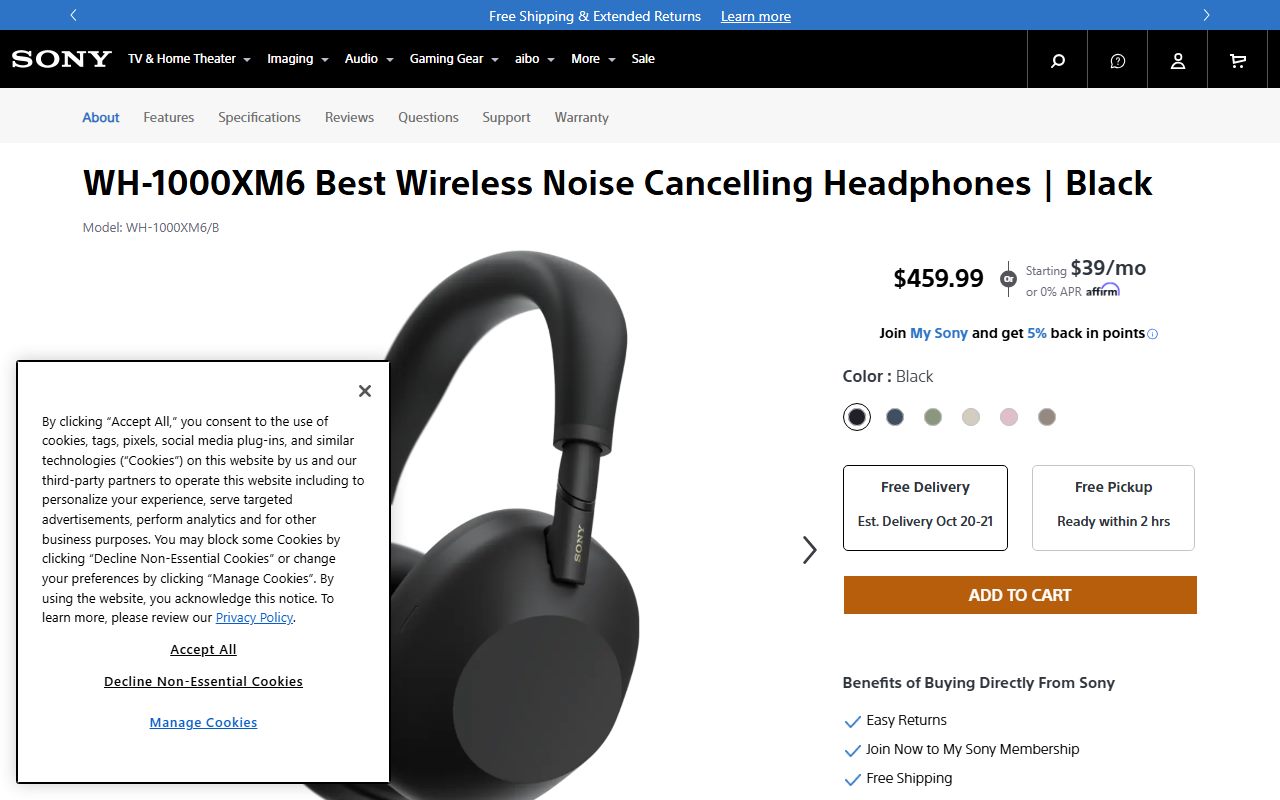
There is one price: $459.99 for every colour on the Sony US store as of October 16, 2026. Colours listed are Black, Midnight Blue, Platinum Silver, Sand Pink and Sandstone, with an Olive Gray swatch also shown on the store page.
Sony's store adds financing from $39 a month through Affirm, a trade-in offer against eligible headphones, 5 percent back in My Sony points for members, and a 3-month Audible Premium Plus trial with registration. None of those change the list price.
What is not in the box matters for the budget: no USB-PD adapter and no USB-C to C cable. The box lists a carrying case, a connection cable, a USB cable, a warranty card and a reference guide.
Against the other flagships read the same day: Bose $449.00, Apple $549.00, Sennheiser $299.95 list shown at $229.95. Sony sits second from the top. Our buying guides explain when the premium is justified.
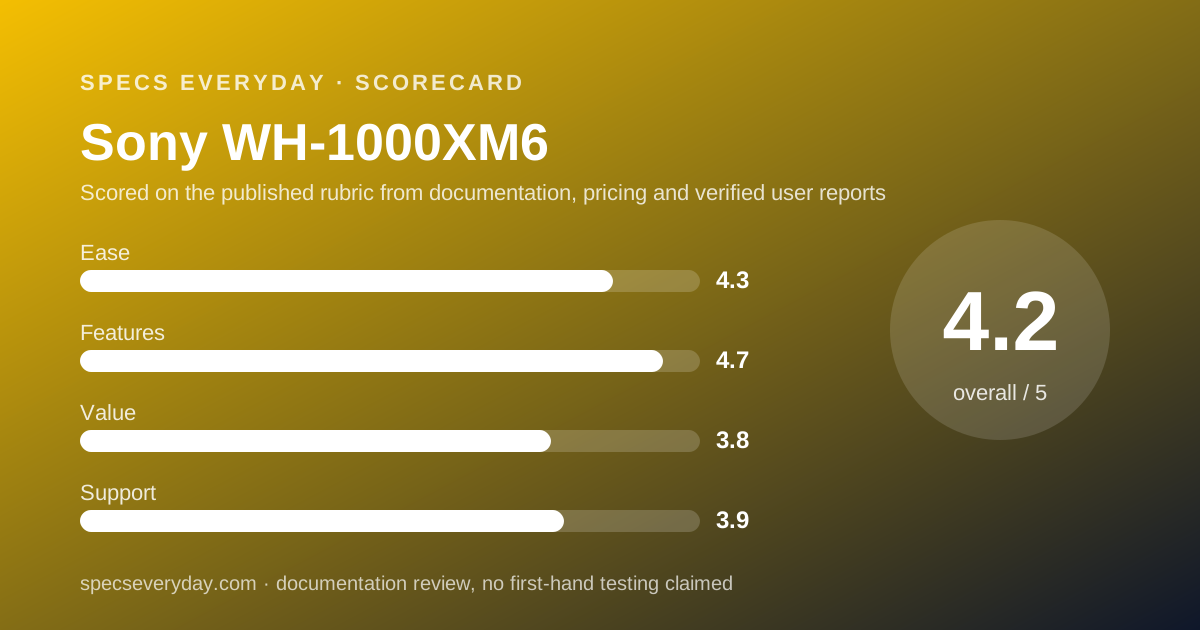
Ease of use: what the 4.3 is built from
The score rests on documented conveniences: multipoint listed as Yes, folding earcups, a touch panel on the right cup, Quick Attention, and a companion app (Sony Sound Connect) that the page references for every advanced setting.
Points come off because several features need the app before they work. LDAC quality mode, Speak-to-Chat and the microphone mute tone are all app-side settings per Sony's footnotes. Google Gemini voice features need a supported Android device.
Features: why it scores 4.7
This is the longest feature list of the four flagship pages we read. Four codecs including LC3, LE Audio profiles, 12 microphones, adaptive noise cancelling with pressure optimising, multipoint, folding, a 40 kHz upper frequency limit on LDAC, and both Bluetooth and cable listening.
The missing three tenths reflect what is not documented: no published decibel figure for noise reduction, no IP rating on the page, and no stated case weight.
Value: why it scores 3.8
At $459.99 the XM6 costs more than the Bose equivalent and $160 more than the Sennheiser list price, while needing an extra adapter to hit its charging headline. The battery, codec and multipoint lines are strong, but a buyer who does not use LDAC pays for a codec they cannot hear.
The score would rise with a street-price discount, which Sony's own store did not show on October 16, 2026.
Support: why it scores 3.9
Sony's support site publishes a complete specification page, a reference guide and firmware through the app, which is why the score is not lower. The reason it is not higher is simple: the warranty duration did not render on the store page's Warranty tab or on the Sony support warranty article when we read both on October 16, 2026.
A warranty card is listed in the box. Until the duration is readable online, we cannot print it, and we will not guess. Our about page explains why a missing number stays missing.
Owner feedback
This read covered Sony's own pages only. We did not pull owner review scores for this edition, so there is no verified-user section yet. It will be added when we have a dated source.
Alternatives from the same spec shelf
Bose QuietComfort Ultra Headphones (2nd Gen), $449.00. Choose Bose if a lighter cup and Bluetooth 5.4 matter more than codec choice. Bose lists up to 30 hours (23 with Immersive Audio) and a 15-minute charge for 3 hours. Otherwise choose Sony for LDAC, LC3 and documented multipoint.
Apple AirPods Max 2, $549.00. Choose Apple if you live inside iPhone, Mac and Apple TV and want lossless over USB-C. Apple lists 20 hours with noise cancelling and 386.2 g. Otherwise choose Sony for 10 more hours and about 130 g less.
Sennheiser MOMENTUM 4 Wireless, $299.95 list. Choose Sennheiser if battery life and price dominate: 60 hours with ANC per the spec sheet, Bluetooth 5.2, aptX Adaptive. Otherwise choose Sony for newer Bluetooth, LC3 and listed multipoint.
Full reviews of all three, and the head-to-head with Bose, publish in the days after this page. The blog will carry a guide to reading these spec sheets yourself.
Bottom line
On paper the Sony WH-1000XM6 is the most complete premium noise-cancelling headphone of October 2026: 30 hours with ANC, four codecs, multipoint, 12 microphones, folding, $459.99. The sheet is honest about its conditions if you read the footnotes, and so are we.
Buy it if you use Android and want everything in one pair. Look at Sennheiser if battery and price lead, at Bose if weight leads, at Apple if your devices are all Apple. Figures are as of October 16, 2026 and may change; our disclosure page explains how we handle links and updates.
Buy it if
- You switch between a laptop and a phone all day and want multipoint that the manufacturer actually lists as Yes
- You use an Android phone and want LDAC at up to 990 kbps, which Sony lists for 96 kHz sampling
- You travel with a backpack and want earcups that fold flat into a case rather than a rigid shell
- You want future-facing Bluetooth with LC3 and the LE Audio profiles already on the spec page
Skip it if
- You want the lightest premium cups: Bose lists 0.583 lb, about 264 g by our conversion, but many owners find the Bose shape lighter on the head; check both weights before deciding
- Battery life is the only line you care about: Sennheiser lists 60 hours for a far lower list price
- You will not buy a USB-PD adapter: without one the headline 3-minute charge does not apply
Frequently asked
How long does the Sony WH-1000XM6 battery last?
Sony's support specification page lists a maximum of 30 hours of continuous music with noise cancelling on and 40 hours with it off, plus 24 and 28 hours for calls. Figures are maximums under Sony's conditions, read October 16, 2026.
Does the Sony WH-1000XM6 support multipoint?
Yes. The specification page lists Multipoint Connection as Yes, and the store FAQ says the headphones can pair with more than one device at a time, with a note that interoperability between Bluetooth devices may vary.
What codecs does the Sony WH-1000XM6 use?
SBC, AAC, LDAC and LC3 over Bluetooth 5.3, per the support page. LDAC at its top setting needs the Priority on Sound Quality option in the Sony Sound Connect app and a source device that supports LDAC.
How fast does the Sony WH-1000XM6 charge?
A full charge takes approximately 3.5 hours over USB. Sony states that 3 minutes of charging gives up to 3 hours of playback, but only with the headphones switched off and an optional USB-PD compatible adapter that is not in the box.
How much does the Sony WH-1000XM6 weigh?
Sony lists approximately 8.96 oz on the specification page. Converted by us that is roughly 254 grams. The page does not list a weight for the carrying case.
Does the Sony WH-1000XM6 fold?
Yes. The store FAQ states the headphones feature folding earcups for portability and storage, and a carrying case is listed in the box alongside a connection cable and a USB cable.
Sources
- Sony US store, WH-1000XM6 product page (price, features, FAQ) - checked October 16, 2026
- Sony support, WH-1000XM6 specifications - checked October 16, 2026
Update history
- October 16, 2026 - First edition from Sony US store and support pages.
Visit Sony WH-1000XM6
We have no affiliate relationship with this vendor. Link goes to the official site.