 Specs
Anker Prime 100W vs UGREEN Nexode 100W: which to buy
Short answer: the UGREEN Nexode 100W 4-port is the better buy for most people, because it has four ports, lists PPS, publishes exactly how its 100 W is split, and cost $39.99 on sale against $69.99 for the Anker on October 17, 2026. The Anker Prime 100W wins for one specific job: keeping a laptop at a full 100 W while a phone charges beside it, in a 170 g body. Both are graded from the makers' product pages, spec tables and warranty terms; this site has not operated either charger.
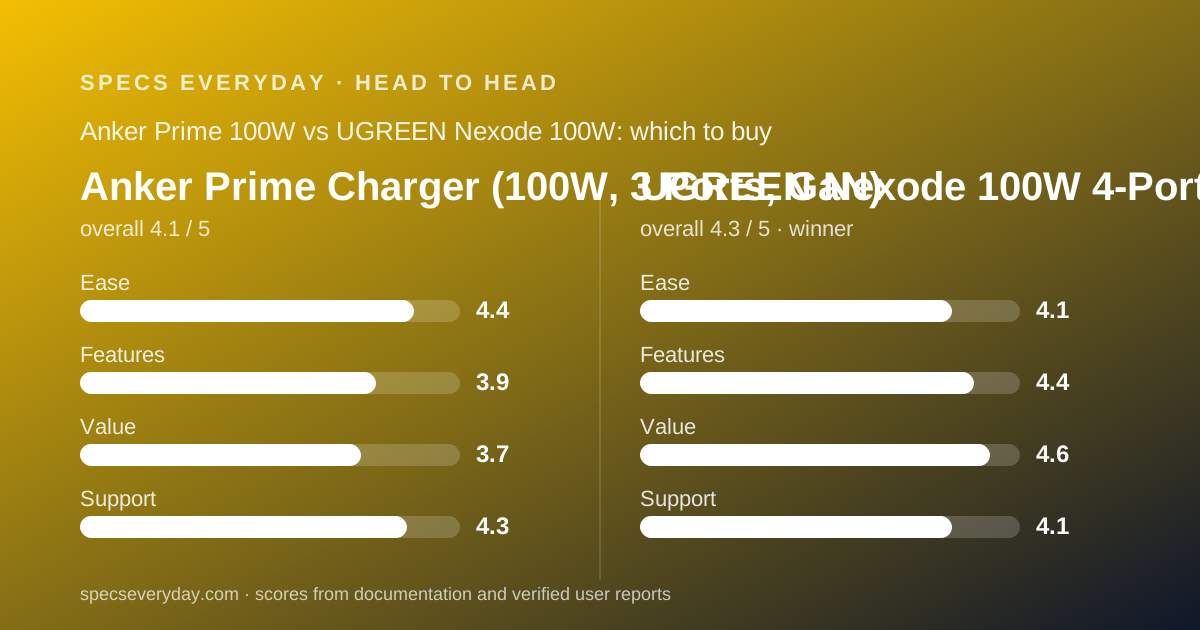
 4.1Anker Prime Charger (100W, 3 Ports, GaN)
 4.3UGREEN Nexode 100W 4-Port Charger
Specification by specification
| Spec | Anker Prime Charger (100W, 3 Ports, GaN) | UGREEN Nexode 100W 4-Port Charger |
|---|---|---|
| Price (maker's US store, Oct 17, 2026) | $69.99 list | $39.99 sale, $54.99 regular |
| Model / SKU | A2688 | 40737 |
| Ports | 2 x USB-C, 1 x USB-A | 3 x USB-C, 1 x USB-A (spec row says 2 + 1) |
| Best single USB-C port | 100 W (either USB-C port) | 100 W (C1 or C2); C3 22.5 W |
| Two USB-C ports in use | 100 W total, split not published | 65 W + 30 W |
| Laptop + phone + earbuds | 89 W total, split not published | 45 W + 30 W + 22.5 W |
| All ports in use | 89 W total (3 ports) | 96 W total (45 + 30 + 10.5 + 10.5 W) |
| USB-A max | 22.5 W | 22.5 W alone, 10.5 W in some combinations |
| Protocols named on page | Not listed | PD 3.0, QC 4+, PPS, AFC, BC1.2 on USB-C |
| Input | 100-240 V, 2.1 A | 100-240 V, 2.3 A max |
| Size | 43.5 x 29 x 67.8 mm | 2.79 x 1.69 x 1.29 in (about 71 x 43 x 33 mm) |
| Weight | 170 g (6 oz) | 7.4 oz (about 210 g) or 0.69 lb (about 313 g); page conflicts |
| Cable in box | No | No |
| Warranty | 24 months | Minimum 2 years |
| Scores (ease / features / value / support) | 4.4 / 3.9 / 3.7 / 4.3 | 4.1 / 4.4 / 4.6 / 4.1 |
The short answer
Two 100 W GaN wall chargers from the two biggest third-party charger brands, $30 apart on October 17, 2026, built around different ideas of what a second port is for.
- The UGREEN Nexode 100W 4-port is best for people charging three or four devices from one socket, Samsung Galaxy owners who want PPS listed, and anyone who wants to know before buying what each port will deliver.
- The Anker Prime 100W is best for one laptop that must keep a full 100 W while a phone charges, and for bags where 170 g and 29 mm thick matter.
- Our pick is the UGREEN, on ports, published detail and price. Both verdicts come from documentation, not from operating the chargers.
The UGREEN publishes every split; the Anker publishes only totals
This is the difference that decides most purchases. UGREEN's product page includes a charging guide that labels the watts on each port in every combination. Anker's spec table gives three totals and one rule.
UGREEN, read October 17, 2026: one device on C1 or C2 gets 100 W. C1 and C2 together get 65 W and 30 W. Add a third device and the first two drop to 45 W and 30 W. All four ports: 45 W, 30 W, 10.5 W and 10.5 W.
Anker, same day: 100 W with one port, 100 W total with two, 89 W total with three, and use the top USB-C port for the laptop when both USB-C ports are busy. How the 100 W or 89 W divides is not stated in the page text, the spec table or the six product images.
For a buyer, a published split is worth more than a slightly higher total. It tells you whether your laptop will gain charge or just hold steady before you spend anything. Read both pages in full in our Anker Prime 100W review and UGREEN Nexode 100W review.
The Anker keeps more power on two ports; the UGREEN caps the laptop at 65 W
Anker's two-port total is 100 W. UGREEN's best two-port combination is 65 W plus 30 W, or 95 W, by our arithmetic from its guide. On paper the Anker delivers 5 W more across two devices.
The practical gap may be larger than 5 W, depending on how Anker divides its total. If the laptop on the top port keeps most of the 100 W, a 14-inch MacBook Pro stays above Apple's 96 W fast-charge bar with a phone attached. Anker does not say whether it does.
On the UGREEN, that laptop gets 65 W the moment a phone joins, just under the 67 W minimum Apple lists for the 14-inch MacBook Pro. It will still charge; it will not fast-charge.
For a MacBook Air or a 65 W Windows laptop, the difference disappears. Apple's adapter list for the MacBook Air runs from 30 W to 70 W, and 65 W covers it.
The UGREEN has a fourth port; the Anker's third port is the only small one
The UGREEN has three USB-C ports and one USB-A port. The Anker has two USB-C and one USB-A.
That extra port has a cost on UGREEN's own guide: the third USB-C port and the USB-A port are small-device ports. Alone they give 22.5 W each; together, or next to a laptop and a phone, they give 10.5 W each.
10.5 W is plenty for earbuds and watches. The Sennheiser MOMENTUM 4 Wireless spec sheet lists USB-C charging at 5 V and 800 mA, about 4 W, and the earbud cases in our commuting earbuds guide are in the same range.
If you charge a laptop, a phone, earbuds and a watch every night, only the UGREEN does it from one socket.
The UGREEN lists PPS; the Anker page names no protocols
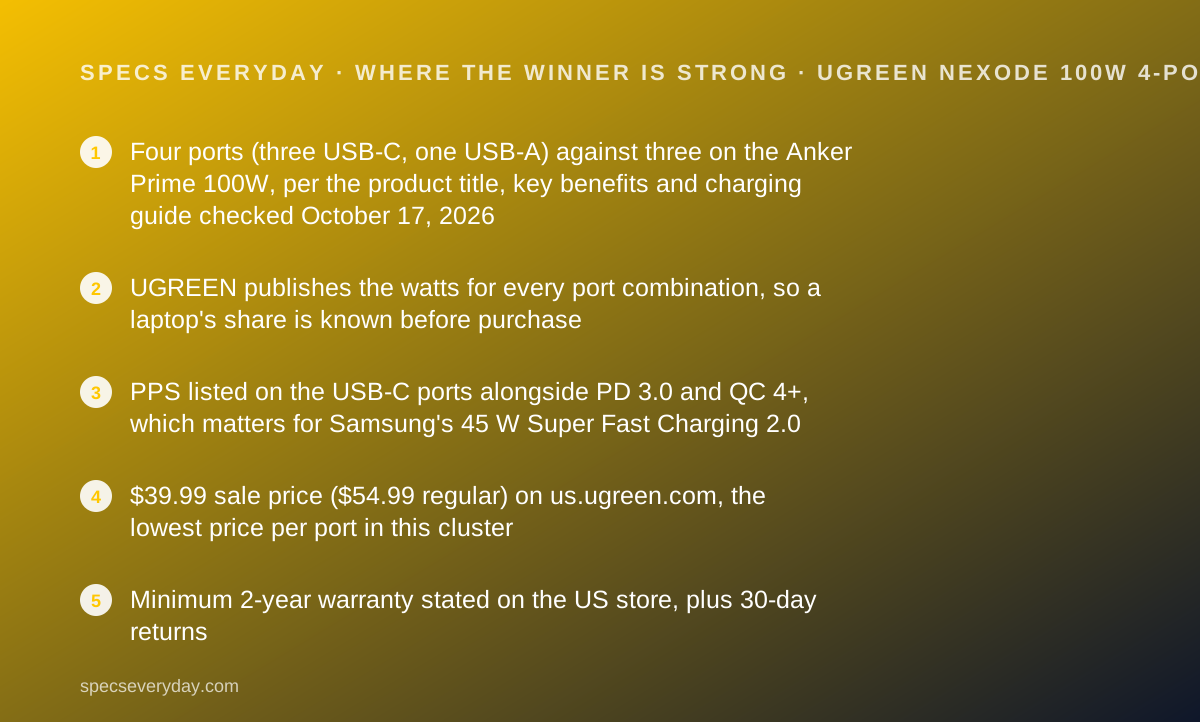
UGREEN's spec table lists PD 3.0 and 2.0, QC 4+ and earlier, PPS, Samsung AFC, Apple 5 V 2.4 A and BC1.2 on its USB-C ports. Anker's page lists voltage steps (5, 9, 15 and 20 V) but no protocol names.
PPS is what Samsung's 45 W Super Fast Charging 2.0 uses. Samsung's own 45 W adapter lists PD 3.0 with PPS at 5-20 V and 2.25 A. UGREEN lists PPS without a current figure, so even it does not confirm the 45 W mode. Anker does not list PPS at all.
For iPhones the picture is different. Apple states the iPhone 17 line reaches 50% in about 20 minutes on a 40 W or higher adapter, which either charger's best port covers. For the iPhone 18 Pro models Apple asks for a 60 W-capable charger with USB-PD 3.2 and Adjustable Voltage Supply; neither page lists those.
UGREEN also lists what it does not support: OnePlus WARP, OPPO VOOC, Xiaomi POCO fast charging and Realme Super Charge. Anker publishes no equivalent list.
The Anker is smaller and lighter; the UGREEN page cannot agree on its weight
Anker lists 43.5 x 29 x 67.8 mm and 170 g. UGREEN's spec table lists 2.79 x 1.69 x 1.29 inches, about 71 x 43 x 33 mm by our conversion, and 7.4 oz, about 210 g. UGREEN's comparison table on the same page lists 0.69 lb, about 313 g.
Either way the Anker is lighter, by 40 g at the least and 143 g at the most. On volume the two are close by our arithmetic from the listed dimensions, about 85 cubic centimetres for the Anker and 100 for the UGREEN.
The UGREEN page also lists 2 USB-C + 1 USB-A in its spec row, which conflicts with its title, its key benefits, its comparison table and its charging guide. We treat that row as an error. It is a small thing, but it is the kind of thing that makes a spec sheet harder to trust.
Scenario by scenario, the UGREEN is predictable and the Anker is stronger at two ports
Here is what each page supports for common nightly loads. UGREEN figures come from its charging guide; Anker figures are totals because that is all Anker publishes.
- Laptop alone: both give 100 W from a USB-C port with a 5 A cable.
- Laptop + phone: UGREEN 65 W + 30 W. Anker 100 W total, laptop on the top port, split not stated.
- Laptop + phone + earbuds: UGREEN 45 W + 30 W + 22.5 W. Anker 89 W total across three ports.
- Laptop + phone + earbuds + watch: UGREEN 45 W + 30 W + 10.5 W + 10.5 W. Anker cannot; it has three ports.
- Two phones and earbuds, no laptop: UGREEN gives 45 W and 30 W to the phones. Anker gives both USB-C ports a share of 89 W with the earbuds on USB-A.
Safety claims: Anker names a system, UGREEN lists protections
Anker leads with ActiveShield 2.0, which its product image says monitors temperature 35 times per second, about 3 million times a day, based on internal lab testing. The page also names advanced over-temperature control.
UGREEN's spec table lists input overvoltage protection and output overcurrent, overvoltage and short-circuit protection, a working temperature range of 0 to 35 C, and standby draw of 0.3 W or less. Its key benefits add overheating protection.
Neither claim can be checked from a product page, and this site has not measured either charger's temperature. What the pages do show is that UGREEN publishes an operating range and a standby figure, and Anker does not.
Pricing: the UGREEN costs $30 less on sale and $15 less at regular price
On October 17, 2026, Anker's US store listed the Prime 100W at $69.99 with no sale shown. UGREEN's US store listed the Nexode 100W 4-port at $39.99, 27% off a $54.99 regular price, during a Halloween sale.
Neither includes a cable. Both need a 5 A USB-C cable to reach 100 W on a single port; a standard 3 A cable caps the port at 60 W. UGREEN's store offered a bundle with two 100 W cables for $46.99 the same day, and Anker sells bundles with its 240 W cable on separate pages.
Per port at sale prices, the UGREEN works out to $10.00 and the Anker to $23.33, by our arithmetic. Even at UGREEN's regular price the gap is $15.
Support: both carry two years; the Anker's terms are clearer
Anker's US warranty table lists 24 months for Anker Prime chargers, against 18 months for its other chargers. Anker's store adds a 30-day money-back guarantee.
UGREEN's US store states a minimum 2-year warranty for manufacturing defects and workmanship under normal use, plus 30-day returns for unused items in original packaging.
On length they match. Anker scores slightly higher on support because its warranty table names the product line, while UGREEN's FAQ images tell owners to contact UGREEN through Amazon messages, which reads as text written for a different store.
Laptop compatibility: Dell owners should read UGREEN's footnote
UGREEN's FAQ image states that Dell laptops can charge at only up to 65 W from Nexode chargers, because of Dell's limits on third-party wall chargers, and may show a slow charger warning.
Anker's notes say Apple's 1.8 m Thunderbolt cable is not compatible with select Samsung, Dell and Lenovo models, and recommend macOS 15 or later and Windows 23H2 for best compatibility. They do not mention a Dell wattage cap.
Neither note means the other charger works better with Dell; it means only UGREEN wrote the limit down. If you own a Dell laptop that ships with a 90 W or 100 W adapter, check Dell's own guidance before relying on either.
At a desk, a monitor may replace both
If the laptop spends most of its day plugged into a monitor, the monitor can be the charger. The BenQ PD2706U and the LG 27UP850K-W list 90 W over USB-C, and the Apple Studio Display lists 96 W, per our reviews.
That changes which charger to buy. If the wall charger is for the bag and the bedside, size wins and the Anker makes sense. If it is the only charger in the house, ports win and the UGREEN does. Our office monitor guide lists which monitors charge a laptop.
Choose the Anker Prime 100W if
These conditions favour the Anker.
- You need 100 W at the laptop with a phone attached - Anker's two-port total is 100 W; the UGREEN gives the laptop 65 W.
- Weight decides what you pack - 170 g against 210 g to 313 g.
- You want the warranty terms printed for the exact product line - Anker's table names Prime chargers at 24 months.
Choose the UGREEN Nexode 100W if
These conditions favour the UGREEN.
- You charge three or four devices at once - it has four ports and publishes what each gets.
- You own a Samsung Galaxy - PPS is listed.
- Your laptop is a MacBook Air or a 65 W Windows machine - 65 W with a phone attached is enough.
- Price matters - $39.99 on sale, $54.99 regular, against $69.99.
Bottom line
For most people the UGREEN Nexode 100W 4-port is the better charger: more ports, a full published split, PPS and a much lower price. The Anker Prime 100W is the specialist pick for a single power-hungry laptop and a light bag. Both need a 5 A cable, and both carry two years of cover.
Frequently asked
Which is better for a MacBook Pro, Anker Prime 100W or UGREEN Nexode 100W?
Alone, both give 100 W from a USB-C port, above Apple's 96 W fast-charge bar for the 14-inch MacBook Pro. With a phone attached, the UGREEN drops the laptop to 65 W, while the Anker keeps a 100 W two-port total but does not publish the split. Neither reaches the 140 W a 16-inch MacBook Pro needs.
Which charger is cheaper?
The UGREEN. On October 17, 2026 it was $39.99 on sale and $54.99 regular on us.ugreen.com, while the Anker Prime 100W was $69.99 on anker.com. Neither includes a cable.
Do either of these chargers support Samsung Super Fast Charging?
UGREEN lists PPS on its USB-C ports, which is the mode Samsung's own 45 W adapter lists for Super Fast Charging 2.0, though UGREEN does not publish a PPS current figure. Anker's page lists no protocols, including PPS.
Which is smaller?
The Anker, at 170 g and 43.5 x 29 x 67.8 mm. UGREEN lists about 71 x 43 x 33 mm and either 7.4 oz or 0.69 lb, depending on which table on its page you read.
Do I need a special cable for 100 W?
Yes, for both. 100 W is 20 V at 5 A, which needs a USB-C cable rated for 5 A with an E-Marker chip. Anker and UGREEN both say so on their pages. A common 3 A cable caps either charger's port at 60 W.
Sources
- Anker Prime Charger (100W, 3 Ports, GaN) A2688 product page and spec table - checked October 17, 2026
- UGREEN Nexode 100W 4-Port Charger product page, spec table and charging guide (US store) - checked October 17, 2026
- Anker US warranty table (refund policy page) - checked October 17, 2026
- Apple Support: Fast charge your MacBook Air or MacBook Pro - checked October 17, 2026
- Apple Support: Fast charge your iPhone - checked October 17, 2026
- Samsung 45W Super Fast Charger 2.0 (EP-T4511) product page, UK - checked October 17, 2026
Visit Anker Prime Charger (100W, 3 Ports, GaN)
We have no affiliate relationship with this vendor. Link goes to the official site.
Visit UGREEN Nexode 100W 4-Port Charger
We have no affiliate relationship with this vendor. Link goes to the official site.