 Specs
Best mesh Wi-Fi systems for a normal house
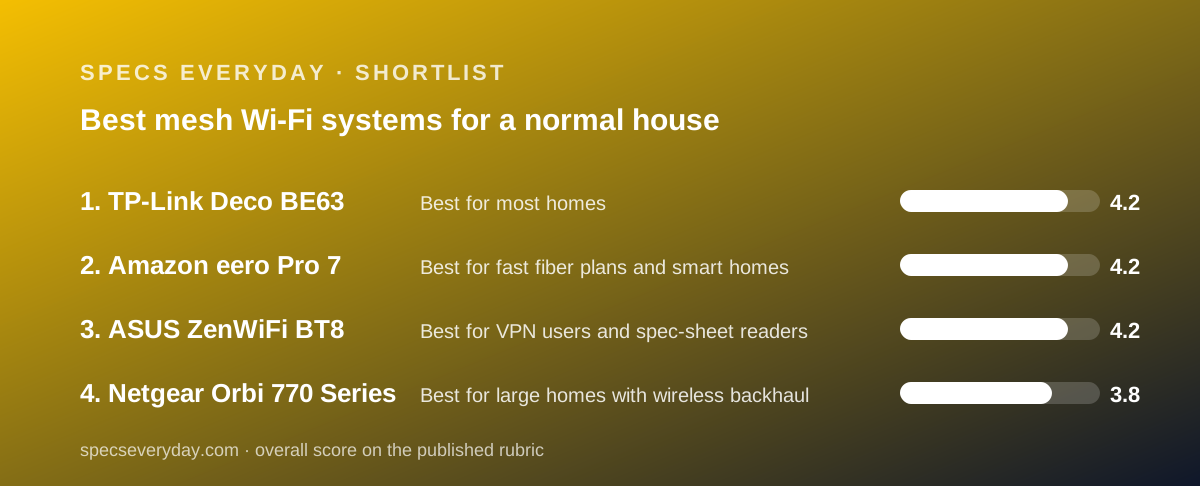
Our top pick for a normal house is the TP-Link Deco BE63, because it publishes its per-band speeds, puts four 2.5 GbE ports on every unit, lists 5,800 sq. ft. for a 2-pack and cost $329.99 on TP-Link's US store on October 16, 2026. The eero Pro 7, ASUS ZenWiFi BT8 and Netgear Orbi 770 Series each win a narrower case. We compared four official spec sheets, pricing pages and warranty pages; we did not run tests of our own.
Our picks
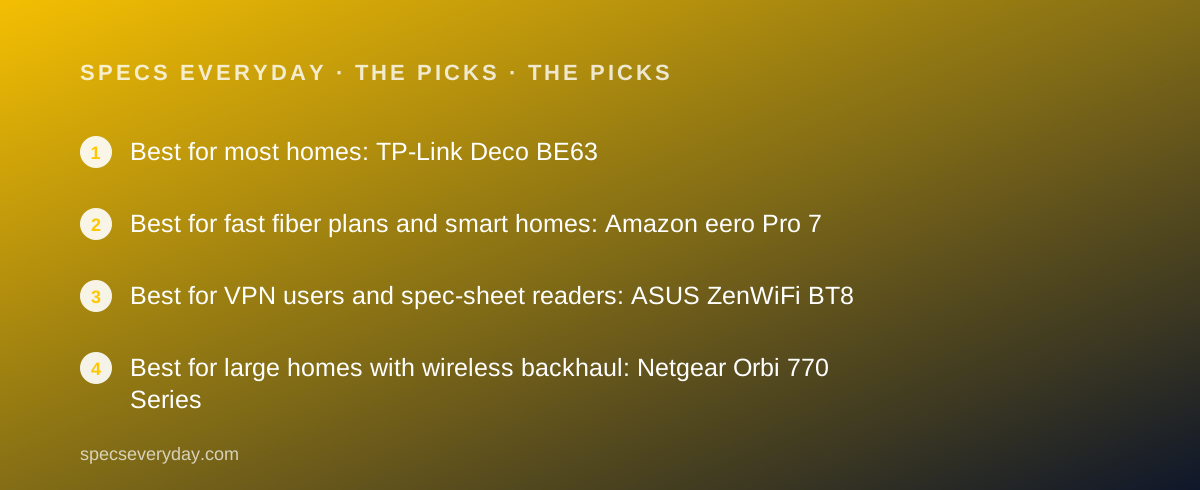
- Best for most homes: TP-Link Deco BE63
- Best for fast fiber plans and smart homes: Amazon eero Pro 7
- Best for VPN users and spec-sheet readers: ASUS ZenWiFi BT8
- Best for large homes with wireless backhaul: Netgear Orbi 770 Series
Who this guide is for
A normal house, for this guide, is 1,800 to 4,000 sq. ft. on an internet plan of 300 Mbps to 2.5 Gbps, with 30 to 80 connected devices. That describes most US single-family homes and larger apartments. If that is you, a 2-pack of any system below is rated by its maker to cover it, and the ranking comes down to ports, transparency and price.
If your home is over 5,000 sq. ft., your plan is 5 Gbps, or you want the router to double as a smart home hub, the order changes, and each product section says how. All four systems are tri-band Wi-Fi 7 mesh kits. Every figure here was read from the maker's own US pages on October 16, 2026, and the full reviews are collected on our Routers and mesh topic page.
The best mesh Wi-Fi systems at a glance
#1 TP-Link Deco BE63, best for most homes on plans up to 2.5 Gbps: four 2.5 GbE ports per unit, 5,800 sq. ft. per 2-pack, 200 devices, 2-year warranty, $329.99 per 2-pack at TP-Link's store price ($449.99 list).
#2 Amazon eero Pro 7, best for 3 to 5 Gbps plans and Thread or Matter smart homes: two 5 GbE ports per unit, 2,000 sq. ft. per unit, 200+ devices, 3-year warranty, $549.99 per 2-pack.
#3 ASUS ZenWiFi BT8, best for VPN users and spec-sheet readers: 3x3 radios on 6 GHz and 5 GHz, 1 GB RAM, 5,900 sq. ft. per 2-pack, device count not published, 3-year warranty, $599.99 per 2-pack.
#4 Netgear Orbi 770 Series, best for large homes with wireless-only backhaul: dedicated backhaul band, 2.5 GbE on every node, 8,000 sq. ft. per 3-pack, 100 devices, warranty duration shown only as an image, $549.99 per 2-pack and $699.99 per 3-pack.
How we picked
We did not run tests of our own; grades come from documentation, pricing pages and verified store listings checked on October 16, 2026. Where a maker did not publish a figure, the table says so instead of guessing, and a missing figure counted against the product.
Ports and WAN speed came first. A mesh for a normal house must carry a 1 to 2.5 Gbps plan on one port and leave wired ports free on every node. We read the port list for the router and for the satellites separately, because they often differ.
Published radio detail came second. Per-band rates, stream counts, channel width and RAM in writing let a buyer compare systems. A single whole-unit figure, as eero publishes, is honest but not comparable.
Coverage and device claims were read with their footnotes. TP-Link says where and how its 5,800 sq. ft. was measured; Netgear notes its 6 GHz band is indoor only. We report the number and the caveat together.
Three-year cost decided ties. Pack price plus the maker's security subscription, if any, over three years, with warranty length as the final tiebreaker. Commission never enters the ranking; none of these products carries an affiliate link from us as of publication, per our disclosure page.
Why the TP-Link Deco BE63 sits at #1
The Deco BE63, sold in the US as the Deco 7 Pro BE10000, is the only system in the group that combines three things: published per-band numbers, four multi-gig ports per unit and a 2-pack under $350 on the day we checked. No rival matches two of the three.
TP-Link's specifications page lists 5,188 Mbps on 6 GHz, 4,324 Mbps on 5 GHz and 574 Mbps on 2.4 GHz, six streams, 2x2 MU-MIMO, 320 MHz channels on 6 GHz and Multi-Link Operation. Every unit has four auto-sensing 2.5 GbE ports and a USB port, so wired backhaul and a wired TV in a far room need no extra hardware.
Coverage is listed at 5,800 sq. ft. for a 2-pack, footnoted as measured in a 4,600 sq. ft. two-story drywall home, and TP-Link lists 200 devices on a lab-test basis. The free tier includes a VPN server and client, a separate IoT network with WPA3, QoS by device and static routing.
On TP-Link's US store on October 16, 2026 the 1-, 2- and 3-packs were $199.99, $329.99 and $396.99 against list prices of $299.99, $449.99 and $599.99. Even at list, the 2-pack undercuts every rival here by at least $100.
The costs: a 2-year warranty for the Deco family in the US, no port above 2.5 Gbps, no Thread or Matter radio, and a HomeShield advanced tier that requires a paid plan whose US price TP-Link does not publish on the web. Read our full TP-Link Deco BE63 review. Choosing between this and the eero? Read eero Pro 7 vs TP-Link Deco BE63.
Why the Amazon eero Pro 7 sits at #2
The eero Pro 7 ranks second on two hardware facts the Deco cannot match. It has two auto-sensing 5 GbE ports per unit, which eero markets for internet plans up to 5 Gbps, and it has a built-in Thread, Zigbee and Matter controller radio set with Bluetooth LE 5.0 that works with Alexa.
eero lists wireless speeds up to 3.9 Gbps, 2,000 sq. ft. and 200+ devices per unit, a 3-year warranty, 30-day returns and free support. On eero.com on October 16, 2026 the 1-, 2- and 3-packs were $299.99, $549.99 and $799.99.
The free eero app includes parental controls and guest access. Advanced security, ad blocking, content filters, Malwarebytes, 1Password and a VPN by Guardian require eero Plus at $9.99 a month or $99.99 a year, per the eero Plus page.
It sits behind the Deco BE63 because its 2-pack cost $220 more at store prices on the day we checked, and because eero publishes no per-band rates, stream counts or RAM, which a spec-sheet ranking has to count against it. It stays ahead of the ASUS and Netgear because of the 5 GbE ports, the smart home hub and a 3-year warranty stated in plain text. Read our full Amazon eero Pro 7 review.
Why the ASUS ZenWiFi BT8 sits at #3
The ZenWiFi BT8 has the strongest published radio package here: 8,643 Mbps on 6 GHz, 4,323 on 5 GHz and 688 on 2.4 GHz, 3x3 radios on the two upper bands, 320 MHz channels, 4K QAM and MLO, with 1 GB of RAM and 128 MB of flash listed outright on the US tech-spec page.
ASUS lists 5,900 sq. ft. for a 2-pack and 3,000 sq. ft. for a single unit. The software list is the deepest in the group: WireGuard, OpenVPN, IPsec and PPTP as server and client, Instant Guard one-tap VPN, dual WAN, 4G/5G phone tethering and AiProtection security with no subscription price listed.
The ASUS US eShop listed the 2-pack at $599.99 with a 3-year manufacturer warranty on October 16, 2026. We did not find US prices for the 1-pack or 3-pack SKUs named on the spec page.
It sits behind the eero Pro 7 because it costs $50 more per 2-pack while listing fewer multi-gig ports (one 2.5G WAN and one 2.5G LAN; the other two LAN ports are 1 Gbps) and no smart home radios, and because ASUS publishes no device count. It ranks above the Orbi because it publishes its numbers, states its warranty in text and charges nothing for security features. A note on sources: ASUS's US product page did not render for us, so marketing figures come from the identical global page. Read our full ASUS ZenWiFi BT8 review.
Why the Netgear Orbi 770 Series sits at #4
The Orbi 770 is a router-plus-satellite design with a dedicated backhaul band, which is the right architecture when the nodes must link wirelessly across a big house. Netgear lists BE11000, up to 11 Gbps derived from the 802.11be specification, 8,000 sq. ft. for the 3-pack, 5,500 for the 2-pack and a quad-core 1.5 GHz processor.
Every node has 2.5 Gbps Ethernet: one WAN and three LAN ports on the router, two LAN ports on each satellite. On netgear.com on October 16, 2026 the 3-pack was $699.99, the 2-pack $549.99 and an add-on satellite $299.99.
It ranks last for a normal house because its advantages do not apply under 5,000 sq. ft. while its costs do. Netgear lists only 100 concurrent devices, half the Deco's figure. It publishes no per-band rates. Armor security is $99.99 a year after a trial of unstated length. The warranty requires registration and purchase from an authorized reseller, and its duration appears only in an image we could not read.
For an 8,000 sq. ft. home with no Ethernet between floors, it would move to the top of this list. Read our full Netgear Orbi 770 Series review.
Also considered
eero Max 7. eero's flagship, listed from $599.99 to $1,699.99 on eero.com on October 16, 2026, with two 10 GbE and two 2.5 GbE ports and 2,500 sq. ft. per unit. Left out because its entry price is double the Pro 7's and a normal house does not need 10 GbE.
TP-Link Deco BE67 (Deco 7 Pro BE14000). Listed on TP-Link's US store beside the BE63 as a 3-pack. Left out because we did not read a full spec sheet for it on October 16, 2026, and we do not rank what we have not read.
ASUS ZenWiFi BT10. ASUS's step-up with 10G ports, named on ASUS pages as the model above the BT8. Left out because its official US page did not render for us and we had no priced US listing to cite.
TP-Link Deco BE25 outdoor unit. Sold in bundles with the BE63 at $399.98 (2-pack bundle) and $569.99 (3-pack bundle) on TP-Link's US store. Left out because it is an add-on for yards and garages, not a system.
Brands we could not document. Several mesh makers sell through affiliate networks we have access to, but we did not find a readable official spec sheet with US pricing for a current Wi-Fi 7 mesh kit from them on October 16, 2026. They will be added when we can read the numbers.
eero Max 7: listed from $599.99 to $1,699.99 on eero.com on October 16, 2026, with two 10 GbE and two 2.5 GbE ports. Entry price double the Pro 7's.
TP-Link Deco BE67 (BE14000): on TP-Link's US store as a 3-pack; full spec sheet not read on October 16, 2026.
ASUS ZenWiFi BT10: 10G step-up; US page did not render and no priced US listing found.
TP-Link Deco BE25 outdoor: add-on sold in BE63 bundles at $399.98 and $569.99, not a system.
How to choose a mesh system from the box
Start with your plan speed, not the BE number. A 2.5 GbE WAN port carries a 2 Gbps plan with room to spare; only a plan above 2.5 Gbps needs the eero Pro 7's 5 GbE port. The BE10000 or BE14000 label is the sum of three per-band maximums that no single device can use at once.
Count the ports on each node, not just the router. Satellites with spare multi-gig ports let you wire a TV or desktop in another room. The Deco BE63 lists four 2.5 GbE per unit; the Orbi 770 satellite lists two; the eero Pro 7 lists two 5 GbE; the ZenWiFi BT8 lists one 2.5G plus two 1G.
Treat coverage figures as a spacing guide. Every maker footnotes its square footage. Use the per-unit number to decide how far apart nodes go, and plan for a third unit if the house has brick, plaster or three floors.
Add the subscription to the price. eero Plus is $99.99 a year, Netgear Armor $99.99 a year, TP-Link's HomeShield advanced tier is unpriced on the web, and ASUS lists AiProtection with no subscription. Over three years that is a $300 swing between systems with similar hardware prices.
Read the warranty line. eero and ASUS list 3 years in plain text; TP-Link lists 2 for the Deco family; Netgear requires registration and shows the duration in an image. For a device you will keep five years, the difference is real.
Decide whether you will ever open the advanced menu. eero's documentation is built around not opening one. ASUS's is built around living in it. TP-Link and Netgear sit between. Buy the one whose documentation matches how you actually behave.
What Wi-Fi 7 adds, in one paragraph
The Wi-Fi Alliance lists 320 MHz channels in the 6 GHz band as providing twice the throughput of Wi-Fi 6, 4K QAM as 20% higher transmission rates than Wi-Fi 6's 1024 QAM, and Multi-Link Operation as load balancing traffic across links for throughput and reliability. For a mesh, MLO backhaul between nodes is the feature that matters most; the headline Gbps figures are per-band maximums that a phone will never see.
Bottom line
For a normal house on a plan of 2.5 Gbps or slower, buy the TP-Link Deco BE63. It publishes its numbers, gives every unit four 2.5 GbE ports, and cost $329.99 for a 2-pack on October 16, 2026, $220 less than the next system here.
Buy the eero Pro 7 if your plan is 3 to 5 Gbps or your smart home runs on Thread and Matter. Buy the ASUS ZenWiFi BT8 if you will use its VPN stack and want security with no subscription. Buy the Netgear Orbi 770 only if the house is large and the backhaul must be wireless.
All prices are US dollars from the makers' own US pages and stores, read October 16, 2026. They will change; confirm before buying. What changed: first published October 16, 2026. Our grading approach is on the about page and the editorial policy page.
Best for most homes: TP-Link Deco BE63
Tri-band BE10000 Wi-Fi 7 with published per-band rates of 5,188, 4,324 and 574 Mbps, four auto-sensing 2.5 GbE ports and a USB port on every unit, 5,800 sq. ft. listed for a 2-pack and 200 devices. $329.99 per 2-pack at TP-Link's US store price on October 16, 2026 ($449.99 list), 2-year US warranty. The value pick for any plan up to 2.5 Gbps; skip it for 5 Gbps plans or if you need a Matter hub.
Only system combining published per-band numbers, four multi-gig ports per unit and a 2-pack under $350 on the day checked.
Visit TP-Link Deco BE63
We have no affiliate relationship with this vendor. Link goes to the official site.
Best for fast fiber plans and smart homes: Amazon eero Pro 7
Tri-band Wi-Fi 7 with two auto-sensing 5 GbE ports per unit for plans up to 5 Gbps, a Thread, Zigbee and Matter controller radio set, 2,000 sq. ft. and 200+ devices per unit, and a 3-year warranty. $549.99 per 2-pack on eero.com on October 16, 2026; eero Plus security is $99.99 a year extra. eero publishes no per-band rates, which keeps it out of first place on a spec-sheet ranking.
Behind the Deco on price and published detail; ahead of ASUS and Netgear on 5 GbE, smart home hub and a plainly stated 3-year warranty.
Visit Amazon eero Pro 7
We have no affiliate relationship with this vendor. Link goes to the official site.
Best for VPN users and spec-sheet readers: ASUS ZenWiFi BT8
BE14000 tri-band Wi-Fi 7 with 3x3 radios on 6 GHz and 5 GHz, per-band rates of 8,643, 4,323 and 688 Mbps, 1 GB RAM, WireGuard and OpenVPN server and client, AiProtection with no subscription listed, 5,900 sq. ft. for a 2-pack and a 3-year warranty. $599.99 per 2-pack on the ASUS US eShop on October 16, 2026. Only one 2.5G LAN port per unit and no published device count.
Costs $50 more than the eero with fewer multi-gig ports; ranks above the Orbi for published numbers, text warranty and free security.
Visit ASUS ZenWiFi BT8
We have no affiliate relationship with this vendor. Link goes to the official site.
Best for large homes with wireless backhaul: Netgear Orbi 770 Series
BE11000 tri-band Wi-Fi 7 router-plus-satellite system with a dedicated backhaul band, 2.5 GbE on every node, 8,000 sq. ft. listed for the 3-pack and a quad-core 1.5 GHz processor. $549.99 per 2-pack and $699.99 per 3-pack on netgear.com on October 16, 2026. Only 100 devices listed, Armor security $99.99 a year after a trial, and a warranty duration Netgear shows only as an image, with registration required.
Its strengths apply above 5,000 sq. ft.; for a normal house the device ceiling, unreadable warranty term and price premium count against it.
Visit Netgear Orbi 770 Series
We have no affiliate relationship with this vendor. Link goes to the official site.
How we chose
We did not run tests of our own; grades come from manufacturer spec sheets, pricing pages, warranty pages and store listings checked on October 16, 2026. Four criteria carried the ranking: ports and WAN speed, published radio detail, coverage and device claims read with their footnotes, and three-year cost including any security subscription, with warranty length as the tiebreaker. Commission never enters the ranking; none of these links carry an affiliate code as of publication.
Frequently asked
Do I need Wi-Fi 7 for a normal house?
Not strictly. Wi-Fi 7 adds 320 MHz channels, 4K QAM and Multi-Link Operation, which the Wi-Fi Alliance describes as twice the throughput of Wi-Fi 6 and 20% higher transmission rates. The mesh benefit is MLO backhaul between nodes. All four systems here are Wi-Fi 7, and the Deco BE63 2-pack at $329.99 costs less than many Wi-Fi 6E kits did.
What is the cheapest good mesh Wi-Fi 7 system?
Among the four we documented, the TP-Link Deco BE63. TP-Link's US store listed the 2-pack at $329.99 and the 3-pack at $396.99 on October 16, 2026, against list prices of $449.99 and $599.99. Both were far below the eero, ASUS and Netgear packs that day.
Is a 2-pack or 3-pack right for a 3,000 sq. ft. house?
A 2-pack is rated to cover it by every maker here: TP-Link lists 5,800 sq. ft., ASUS 5,900, Netgear 5,500 and eero about 4,000 by our arithmetic from 2,000 per unit. Choose a 3-pack if the house has three floors, brick or plaster walls, or a detached room.
Which mesh system has the longest warranty?
eero Pro 7 and ASUS ZenWiFi BT8 both list 3 years in plain text as of October 16, 2026. TP-Link lists 2 years for the Deco family. Netgear requires registration and purchase from an authorized reseller, and shows the duration in an image we could not read.
Which mesh system is best for a 5 Gbps plan?
The eero Pro 7, which lists two auto-sensing 5 GbE ports and is marketed for plans up to 5 Gbps. The Deco BE63, Orbi 770 and ZenWiFi BT8 all top out at 2.5 Gbps on any single port, per their spec sheets read October 16, 2026.
Do these systems need a subscription?
None requires one to run. eero Plus is $9.99 a month or $99.99 a year; Netgear Armor is $99.99 a year after a trial; TP-Link's HomeShield advanced tier is paid but unpriced on the web; ASUS lists AiProtection with no subscription. Budget for the one you will actually use.