 Specs
eero Pro 7 vs TP-Link Deco BE63: which mesh fits your home
Both are tri-band Wi-Fi 7 mesh systems sold as identical units, and both were read from their official pages on October 16, 2026. The eero Pro 7 wins on WAN speed, warranty and smart home radios; the Deco BE63 wins on ports, published numbers and price by a wide margin. For most homes on a plan of 2.5 Gbps or slower, the Deco BE63 is the better buy. This is a documentation comparison, not a test.
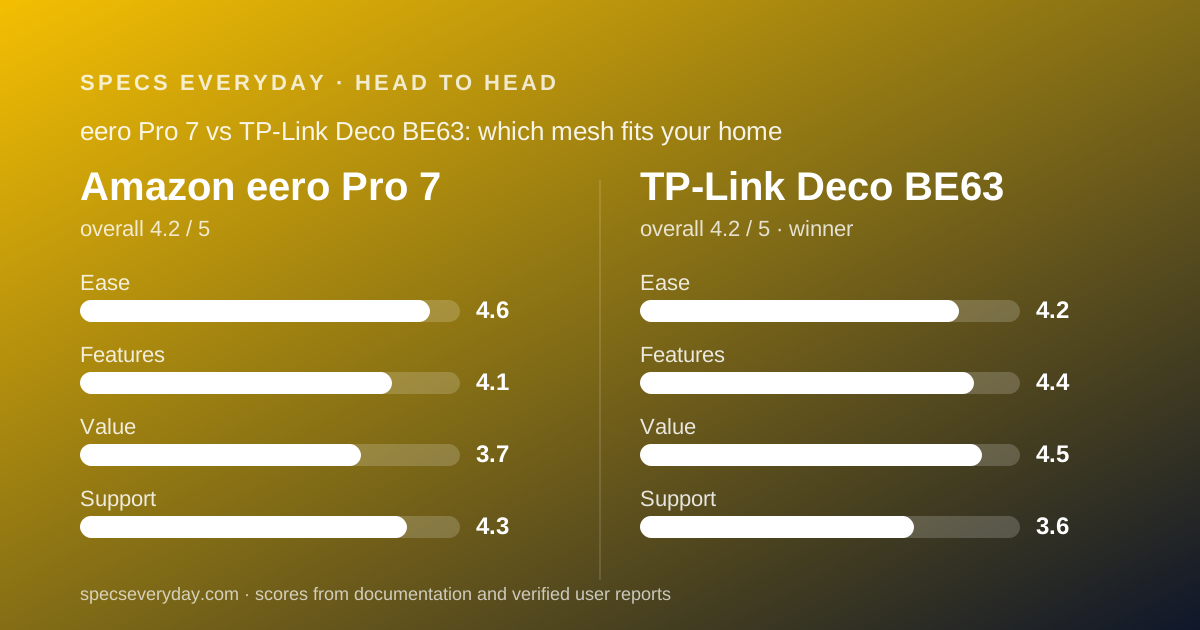
 4.2Amazon eero Pro 7
 4.2TP-Link Deco BE63
Specification by specification
| Spec | Amazon eero Pro 7 | TP-Link Deco BE63 |
|---|---|---|
| Wi-Fi class | Wi-Fi 7 tri-band (no class label published) | Wi-Fi 7 tri-band, BE10000 |
| Stated wireless speed | Up to 3.9 Gbps (whole unit) | 5,188 + 4,324 + 574 Mbps per band |
| Ethernet ports per unit | 2 x 5 GbE auto-sensing | 4 x 2.5 GbE auto-sensing + USB |
| Fastest internet plan one port can carry | 5 Gbps | 2.5 Gbps |
| Coverage | 2,000 sq. ft. per unit | 5,800 sq. ft. per 2-pack |
| Device support | 200+ per unit | 200 (lab test basis) |
| Smart home radios | Thread, Zigbee, Matter controller, BLE 5.0 | Not listed |
| Built-in VPN server | Not listed (VPN via eero Plus) | OpenVPN, PPTP, L2TP/IPSec |
| Security subscription | eero Plus $9.99/mo or $99.99/yr | HomeShield advanced tier, price not published on web |
| Warranty (US) | 3 years | 2 years |
| 2-pack price, Oct 16, 2026 | $549.99 (eero.com) | $329.99 store price, $449.99 list (TP-Link US store) |
| 3-pack price, Oct 16, 2026 | $799.99 | $396.99 store price, $599.99 list |
| Our scores (ease / features / value / support) | 4.6 / 4.1 / 3.7 / 4.3 | 4.2 / 4.4 / 4.5 / 3.6 |
The short answer
Two sentences settle most households.
- The eero Pro 7 is best for homes on a 3 to 5 Gbps plan, Thread or Matter smart home setups, and anyone who wants a 3-year warranty and the simplest possible app
- The TP-Link Deco BE63 is best for homes on a plan of 2.5 Gbps or slower that want four multi-gig ports per unit, published per-band numbers and the lowest price
- Winner for a normal house: the Deco BE63. On October 16, 2026 its 2-pack was $220 cheaper than the eero Pro 7 2-pack while listing more ports and more coverage
- Every figure here is from eero.com, tp-link.com and TP-Link's US store as read on October 16, 2026; neither system was run by us
The Deco BE63 publishes its radio numbers; eero publishes one
TP-Link's specifications page lists 5,188 Mbps on 6 GHz, 4,324 Mbps on 5 GHz and 574 Mbps on 2.4 GHz, six streams, 2x2 MU-MIMO and 320 MHz channels on 6 GHz. Adding the bands gives 10,086 Mbps, our arithmetic, which is the BE10000 label.
eero's product page states wireless speeds up to 3.9 Gbps for the whole unit and nothing per band. It does not list stream counts, channel width or RAM.
That gap does not mean the eero radio is slower. It means a buyer cannot compare the two from official pages. The Wi-Fi Alliance describes 320 MHz channels as twice the throughput of Wi-Fi 6, and only TP-Link confirms them in writing. Read the full breakdown in our TP-Link Deco BE63 review and Amazon eero Pro 7 review.
Ports: eero wins on top speed, Deco wins on count
The eero Pro 7 has two auto-sensing 5 GbE ports per unit. eero markets it as ideal for internet plans up to 5 Gbps, and that is the one hardware point where it is clearly ahead: a 5 Gbps fiber plan can enter on one cable.
The Deco BE63 has four auto-sensing 2.5 GbE ports per unit plus a USB port. TP-Link states only one port can be WAN at a time, so the fastest plan it can fully carry is 2.5 Gbps. In exchange, every unit has three spare wired ports for a TV, console or desktop.
For the majority of US homes, where plans top out at 1 or 2 Gbps, the Deco layout is more useful. For the minority on 3 to 5 Gbps, the eero port is the deciding factor.
Coverage and devices: TP-Link states more area, eero states more per unit
TP-Link lists up to 5,800 sq. ft. for a 2-pack, based on a footnoted test in a 4,600 sq. ft. two-story drywall home. eero lists 2,000 sq. ft. per unit, which implies roughly 4,000 sq. ft. for two units by our arithmetic.
On devices, TP-Link lists 200 based on laboratory test data; eero lists 200+ per unit. Both are manufacturer figures with footnotes, and neither is a guarantee.
The practical reading: for a 3,000 to 4,000 sq. ft. home, both 2-packs are rated to cover it. For 5,000 sq. ft. and up, TP-Link's stated figure is the only one that reaches, though a third unit of either system is the safer plan. Larger homes should also read our Netgear Orbi 770 Series review, which lists 8,000 sq. ft. for a 3-pack.
Pricing: Deco costs less at every pack size
On October 16, 2026, eero.com listed the Pro 7 at $299.99, $549.99 and $799.99 for 1, 2 and 3 units. TP-Link's US store listed the BE63 at $199.99, $329.99 and $396.99 against list prices of $299.99, $449.99 and $599.99.
At list price, the Deco 2-pack is $100 below the eero 2-pack and the Deco 3-pack is $200 below. At the store prices shown that day, the gaps were $220 and $403. Those are our subtractions from the published figures.
The subscriptions change the math only if you buy them. eero Plus is $9.99 a month or $99.99 a year with advanced security, ad blocking, content filters, Malwarebytes, 1Password and a VPN by Guardian. TP-Link's HomeShield advanced tier needs a paid plan whose US price TP-Link does not publish on the web; it appears in the Deco app. We cannot compare what we cannot read.
All prices are US dollars. Neither system was purchased by us, and we have no commission arrangement with either company; see the disclosure page.
Features: eero has the smart home hub, Deco has the toolbox
The eero Pro 7 includes a Thread, Zigbee and Matter (controller only) radio set with Bluetooth LE 5.0, and works with Alexa as a smart home hub. TP-Link's page does not mention Thread or Matter; it offers a separate IoT network with WPA3 and Tapo and Kasa onboarding instead.
The Deco BE63 includes a VPN server and client (OpenVPN, PPTP, L2TP/IPSec), static routing, QoS by device, band preference and a USB port, all listed on the free tier. eero's documentation lists none of those; its VPN is part of eero Plus.
Both state Multi-Link Operation and backward compatibility with their own earlier units. eero adds that it works with eero Built-in on select Echo devices. Which list matters depends on whether you own smart home gear or want to run a VPN.
Ease of use: eero is simpler by design
eero's documented experience is set up, share, control, relax, all in the app, with TrueMesh, TrueRoam and TrueChannel handling optimization. Its auto-sensing 5 GbE ports mean there is no wrong jack.
TP-Link's Deco app is documented with a guided setup and auto-sensing ports too, but the feature list is longer and HomeShield upsells live inside the same app. For a first-time mesh owner, eero's page describes fewer decisions; for a tinkerer, Deco's describes more options.
Our ease scores, 4.6 for eero and 4.2 for Deco, follow that reading of the documentation.
Support: eero's 3-year warranty beats TP-Link's 2
eero's product page lists a 3-year warranty, 30-day returns, free shipping and free support. TP-Link's US replacement and warranty page lists 2 years for the Deco family for purchases on or after September 1, 2023.
Neither company states how long free technical support lasts or a firmware update horizon on the pages we read. The extra warranty year is the concrete difference, and it is worth something on a product most people keep for five years or more.
The ASUS ZenWiFi BT8 also lists 3 years, for buyers weighing warranty across the whole group.
Backhaul: both use MLO, only Deco documents the wired option fully
How the nodes talk to each other decides whether a mesh feels fast in the far bedroom. Both makers state Multi-Link Operation, the Wi-Fi 7 feature the Wi-Fi Alliance describes as load balancing traffic among links for throughput and reliability.
TP-Link goes further in writing. Its page says Deco combines wired and tri-band Wi-Fi 7 links with MLO between units, and the four 2.5 GbE ports per node mean any unit can be wired to any other at 2.5 Gbps without a switch.
eero's page states that TrueMesh builds on the Qualcomm Dragonwing N7 platform to minimize slowdowns and that the Pro 7 supports MLO. It does not describe wired backhaul on the product page, though either 5 GbE port is auto-sensing and could serve that role.
Neither system has a dedicated backhaul band. For a house where the nodes must link over the air across three floors, the Netgear Orbi 770 Series is the system in this group built around one.
Security and privacy: Deco lists more for free, eero charges for the extras
On the free tier, TP-Link lists WPA3-Personal, guest networks on all three bands, a separate IoT network with device isolation, a home network scanner, malicious site blocking, intrusion prevention and DDoS prevention under the HomeShield basic umbrella, plus the built-in VPN server and client.
eero lists WPA3 and a free app with parental controls, guest access and automatic updates. Advanced security, ad blocking, content filters, Malwarebytes, 1Password and the Guardian VPN are eero Plus features at $99.99 a year.
TP-Link's catch is that it does not say on the web which HomeShield protections are basic and which are advanced, and it footnotes that some features are still under development. eero's catch is the subscription itself.
Neither page describes what browsing data the maker collects, so we do not characterize either company's data practices here. Read each privacy policy before buying; both are linked from the official product pages.
Three-year cost: Deco stays ahead even if you never subscribe to eero Plus
This section is our arithmetic from the published figures, not a maker claim. Hardware only, 2-pack, at October 16, 2026 prices: eero Pro 7 $549.99, Deco BE63 $329.99 at store price or $449.99 at list. The gap is $220 at store price and $100 at list.
Add a security subscription for three years. eero Plus at $99.99 a year adds $299.97, taking a Pro 7 2-pack to $849.96. The Deco's HomeShield advanced tier has no published US price, so we cannot add it; at list price without a subscription the Deco 2-pack stays at $449.99.
Warranty changes the risk, not the price. eero's 3-year term covers the whole period in this calculation; TP-Link's 2-year term leaves the third year uncovered. A buyer who wants the extra year could set aside the $100 list-price difference as self-insurance and still come out even.
For a 3-pack the gap widens: $799.99 for eero against $396.99 store or $599.99 list for Deco, a difference of $403 or $200 before any subscription.
Which to pick by internet plan
The plan speed settles the choice faster than any other line on the spec sheet.
- 300 Mbps to 1 Gbps: Deco BE63. Either system is far faster than the plan; the Deco's extra ports and lower price decide it
- 2 Gbps to 2.5 Gbps: Deco BE63, narrowly. Its 2.5 GbE WAN carries the plan fully, and the price gap is the same $220
- 3 Gbps to 5 Gbps: eero Pro 7. The 5 GbE port is the only one in this pair that can carry the plan on one cable
- Above 5 Gbps: neither. eero lists the eero Max 7 with 10 GbE ports from $599.99; TP-Link's BE63 page lists nothing above 2.5 Gbps
What owners report
TP-Link's US store showed a 4.8 average from 85 customer reviews on October 16, 2026, highlighting setup ease, coverage and performance. That is a retailer-hosted figure and a small sample.
eero.com did not expose a readable owner review feed on the page we read, so we have no comparable figure for the Pro 7. We do not quote individual reviews for either product.
Choose the eero Pro 7 if
The eero case is narrow but real.
- Your internet plan is 3 to 5 Gbps and you want one port to carry it
- You run Thread or Matter devices and want the router to be the hub
- You already own eero units and want them to stay on the network
- You value the 3-year warranty and the simplest documented setup
Choose the TP-Link Deco BE63 if
The Deco case covers most households.
- Your plan is 2.5 Gbps or slower, which is most US homes
- You want wired ports on every node for TVs, consoles or a desktop
- You want a VPN server and IoT isolation without a subscription
- Price matters: $329.99 for a 2-pack on October 16, 2026, versus $549.99
Bottom line
The Deco BE63 is the better mesh for a normal house. It publishes its numbers, lists four 2.5 GbE ports per unit and 5,800 sq. ft. for a 2-pack, and cost $220 less than the eero Pro 7 2-pack on October 16, 2026.
Buy the eero Pro 7 instead when the plan is faster than 2.5 Gbps, when Thread and Matter matter, or when a 3-year warranty and a one-screen app are worth the premium.
Both systems sit alongside the Netgear Orbi 770 and ASUS ZenWiFi BT8 on our Routers and mesh topic page, where the ranked guide will appear once published. Figures were read October 16, 2026 and will change; confirm on the official pages. Our method is on the editorial policy page.
Frequently asked
Which is cheaper, the eero Pro 7 or the Deco BE63?
The Deco BE63. On October 16, 2026, TP-Link's US store listed the BE63 2-pack at $329.99 (list $449.99) and the 3-pack at $396.99 (list $599.99), while eero.com listed the Pro 7 at $549.99 and $799.99. All prices in US dollars.
Can the eero Pro 7 and Deco BE63 be mixed in one mesh?
No. Each system only meshes with its own brand: eero with earlier eero units and eero Built-in Echo devices, Deco with other Deco units. Switching brands means replacing every node, which is why pack size matters at purchase.
Which is better for a 5 Gbps fiber plan?
The eero Pro 7. It lists two auto-sensing 5 GbE ports and eero markets it for plans up to 5 Gbps. The Deco BE63 tops out at 2.5 Gbps on any single port, per TP-Link, so a 5 Gbps plan cannot be fully used.
Which has the longer warranty?
The eero Pro 7, at 3 years per eero.com. TP-Link lists 2 years for the Deco family in the US for purchases on or after September 1, 2023. Both figures were read on October 16, 2026.
Do both need a subscription for security features?
Both work without one. eero Plus costs $9.99 a month or $99.99 a year for advanced security, ad blocking and a VPN. TP-Link's HomeShield has free basics and a paid advanced tier whose US price is shown only in the Deco app, not on the web pages we read.
Visit Amazon eero Pro 7
We have no affiliate relationship with this vendor. Link goes to the official site.
Visit TP-Link Deco BE63
We have no affiliate relationship with this vendor. Link goes to the official site.