 Specs

Netgear Orbi 770 Series
BE11000 tri-band Wi-Fi 7 mesh with a dedicated backhaul band and 8,000 sq. ft. stated coverage from a 3-pack, read from the spec sheet
Scored on the published rubric, from documentation, pricing and verified user reports.
Best for: Large single-family homes that cannot run Ethernet between floors and want a router-plus-satellite design with a dedicated wireless backhaul band and 2.5 GbE on every node.
Verdict
The Netgear Orbi 770 Series is the system for a big house where the mesh has to work over the air. This is a documentation review built from netgear.com as read on October 16, 2026, not from testing. Netgear lists a BE11000 tri-band Wi-Fi 7 system with enhanced dedicated backhaul, up to 8,000 sq. ft. from the 3-pack, 100 concurrent devices and a quad-core 1.5 GHz processor. The router has one 2.5 Gbps WAN and three 2.5 Gbps LAN ports; each satellite has two 2.5 Gbps LAN ports. The 3-pack is $699.99 and the 2-pack $549.99 in US dollars. The weak points are also documented. Netgear's 100-device figure is half of what eero and TP-Link list, the warranty duration is shown only in an image we could not read and requires registration, Armor security costs $99.99 a year after a trial of unstated length, and 6 GHz is flagged as indoor only. If your home is 5,000 sq. ft. or more and wiring is not an option, the Orbi design makes sense; otherwise the TP-Link Deco BE63 does most of the same job for far less.
Visit Netgear Orbi 770 Series
We have no affiliate relationship with this vendor. Link goes to the official site.
Where it is strong
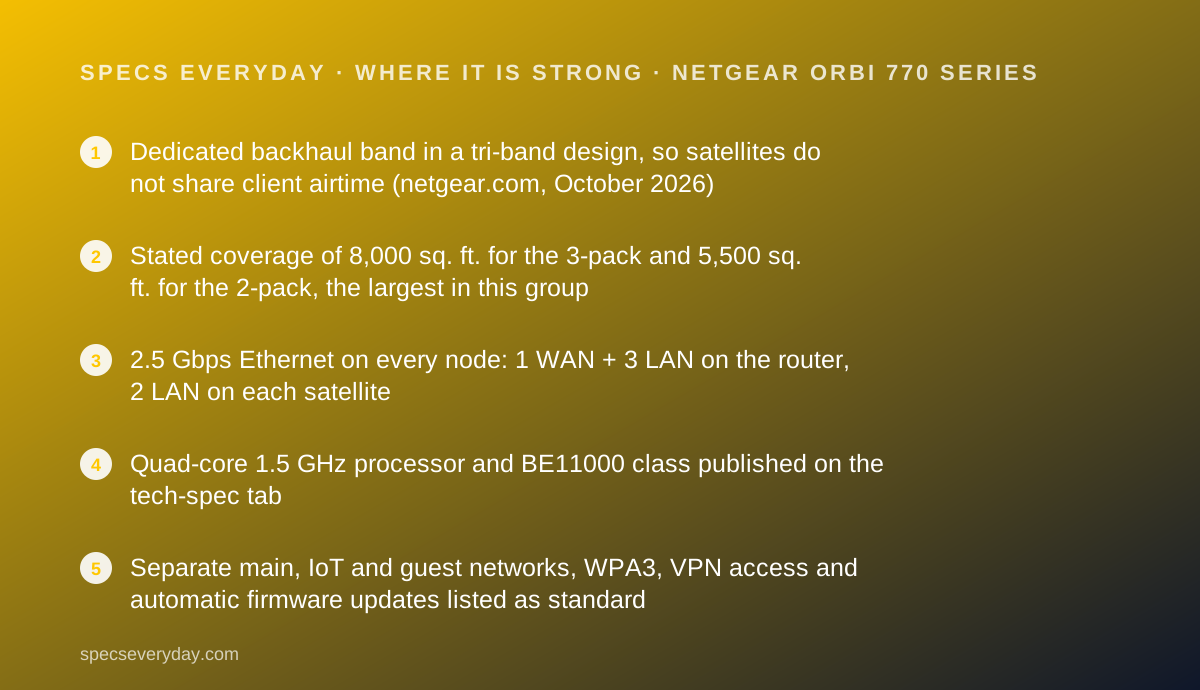
- Dedicated backhaul band in a tri-band design, so satellites do not share client airtime (netgear.com, October 2026)
- Stated coverage of 8,000 sq. ft. for the 3-pack and 5,500 sq. ft. for the 2-pack, the largest in this group
- 2.5 Gbps Ethernet on every node: 1 WAN + 3 LAN on the router, 2 LAN on each satellite
- Quad-core 1.5 GHz processor and BE11000 class published on the tech-spec tab
- Separate main, IoT and guest networks, WPA3, VPN access and automatic firmware updates listed as standard
Where it falls short
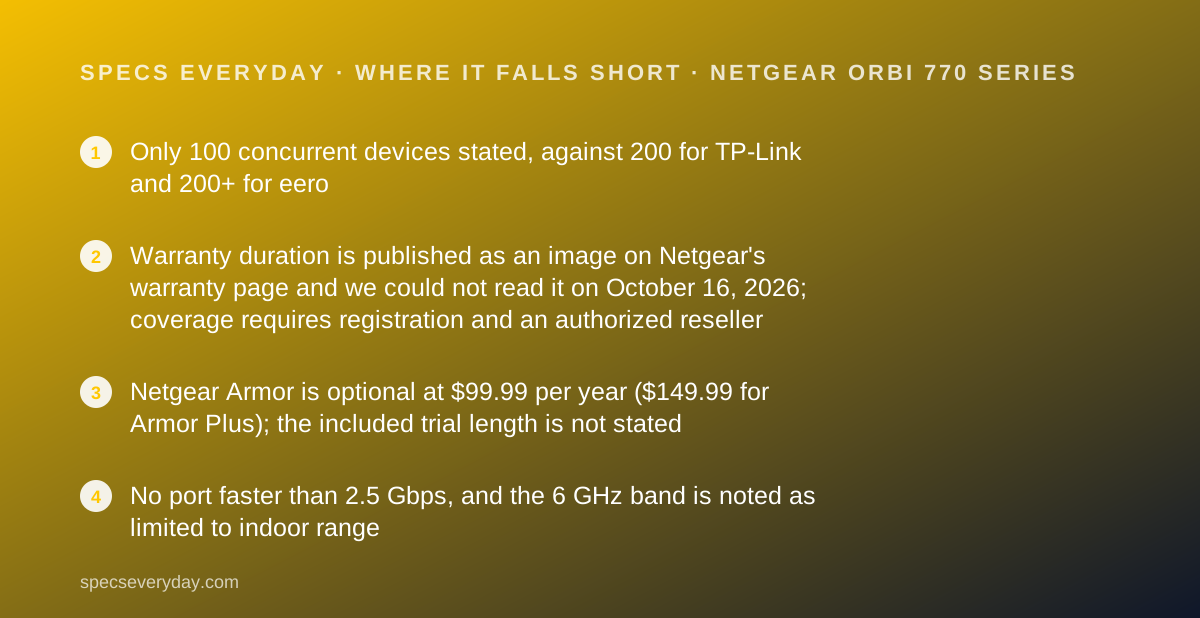
- Only 100 concurrent devices stated, against 200 for TP-Link and 200+ for eero
- Warranty duration is published as an image on Netgear's warranty page and we could not read it on October 16, 2026; coverage requires registration and an authorized reseller
- Netgear Armor is optional at $99.99 per year ($149.99 for Armor Plus); the included trial length is not stated
- No port faster than 2.5 Gbps, and the 6 GHz band is noted as limited to indoor range
At a glance
| Wi-Fi standard | Wi-Fi 7 (802.11be), simultaneous tri-band, BE11000 class |
|---|---|
| Stated maximum speed | Up to 11 Gbps (from the 802.11be spec) |
| Backhaul | Dedicated band, enhanced backhaul; 2.5 Gbps wired option |
| Router ports | 1 x 2.5 Gbps WAN, 3 x 2.5 Gbps LAN |
| Satellite ports | 2 x 2.5 Gbps LAN each |
| Coverage | 3-pack up to 8,000 sq. ft.; 2-pack 5,500; each unit 2,500 (tech specs) |
| Device support | Up to 100 concurrent devices |
| Processor | Quad-core 1.5 GHz |
| Unit size and weight | 5.28 in wide, 3.95 in deep, 2.02 lb |
| Price (USD) | $549.99 (2-pack) / $699.99 (3-pack) / $299.99 add-on satellite |
| Pricing note | netgear.com, checked October 16, 2026: RBE772 2-pack $549.99, RBE773 3-pack $699.99, RBE770 add-on satellite $299.99; Armor optional at $99.99/year, Armor Plus $149.99/year |
What the Orbi 770 Series actually is
The Orbi 770 Series is Netgear's mid-range Wi-Fi 7 mesh. Unlike eero and TP-Link, which sell identical units, Orbi uses a router (RBE771) plus satellites (RBE770). The 3-pack is sold as RBE773 and the 2-pack as RBE772.
Netgear's tech-spec tab, read October 16, 2026, lists simultaneous tri-band Wi-Fi 7 across 2.4 GHz, 5 GHz and 6 GHz with enhanced backhaul, a BE11000 class rating and a quad-core 1.5 GHz processor. The headline figure is up to 11 Gbps, which Netgear footnotes as derived from the 802.11be specification.
Netgear does not break the 11 Gbps down by band on the page, and it does not state stream counts, RAM or channel width. That makes direct radio comparisons with the TP-Link Deco BE63, which publishes all three per-band rates, impossible from official pages.
This is a documentation review. Nothing on this page comes from running the hardware; the method is explained on the editorial policy page.
Who the Orbi 770 is best for
Netgear's own positioning and the spec sheet agree on the buyer.
- Owners of large homes: 8,000 sq. ft. for the 3-pack is the biggest stated coverage in our Routers and mesh group
- Homes where Ethernet between floors is not possible, because the dedicated backhaul band is designed for wireless satellite links
- Households on a 1 to 2.5 Gbps plan that want multi-gig on every node, including satellites
- People who prefer a clear router-and-satellite hierarchy over interchangeable units
- Buyers who will register the product, since Netgear ties the warranty to registration
- Anyone who wants separate main, IoT and guest networks out of the box
Who should skip it
Skip the Orbi 770 if you have a lot of devices. Netgear's stated ceiling is 100 concurrent devices, half the figure TP-Link lists for the Deco BE63 and below the 200+ eero lists for the Amazon eero Pro 7.
Skip it if your plan is above 2.5 Gbps, because every port is 2.5 Gbps. And skip it if you want a warranty term you can read before buying; on October 16, 2026, Netgear's duration table was an image we could not parse.
What is included free and what sits behind Armor
The free layer, per the network security section of the product page, includes the Orbi app, separate main, IoT and guest Wi-Fi networks, access control, WPA3, automatic firmware updates and VPN support for remote access to the home network.
Netgear Armor, powered by Bitdefender, is optional. The product page says a trial is included and that terms and conditions apply, without stating how long the trial runs.
The Armor page, read October 16, 2026, lists Armor from $99.99 per year (shown as $8.33 a month billed annually) and Armor Plus at $149.99 per year. Features across the two tiers include threat protection, antivirus for 50 devices, scam protection, dark web monitoring, a VPN, an ad blocker and an extended warranty, though the table does not clearly map every feature to a tier.
In plain terms: the mesh works without paying. Device-level antivirus and the VPN cost at least $99.99 a year after the trial.
How the pricing is structured
Netgear sells the Orbi 770 by pack on netgear.com. On October 16, 2026 the 3-pack was $699.99, the 2-pack $549.99 and a single add-on satellite $299.99, all in US dollars.
By our arithmetic, the third unit in the 3-pack costs $150 more than the 2-pack, which is $149.99 less than buying the satellite separately. A 4-node system (3-pack plus one satellite) would be $999.98.
Against the group: the 2-pack matches the eero Pro 7 2-pack at $549.99 to the cent, and the 3-pack is $100 below eero's $799.99. Both sit well above the Deco BE63, which TP-Link's store showed at $329.99 for a 2-pack and $396.99 for a 3-pack the same day.
We have no commission arrangement with Netgear; see the disclosure page. Prices on netgear.com move often, so check before buying.
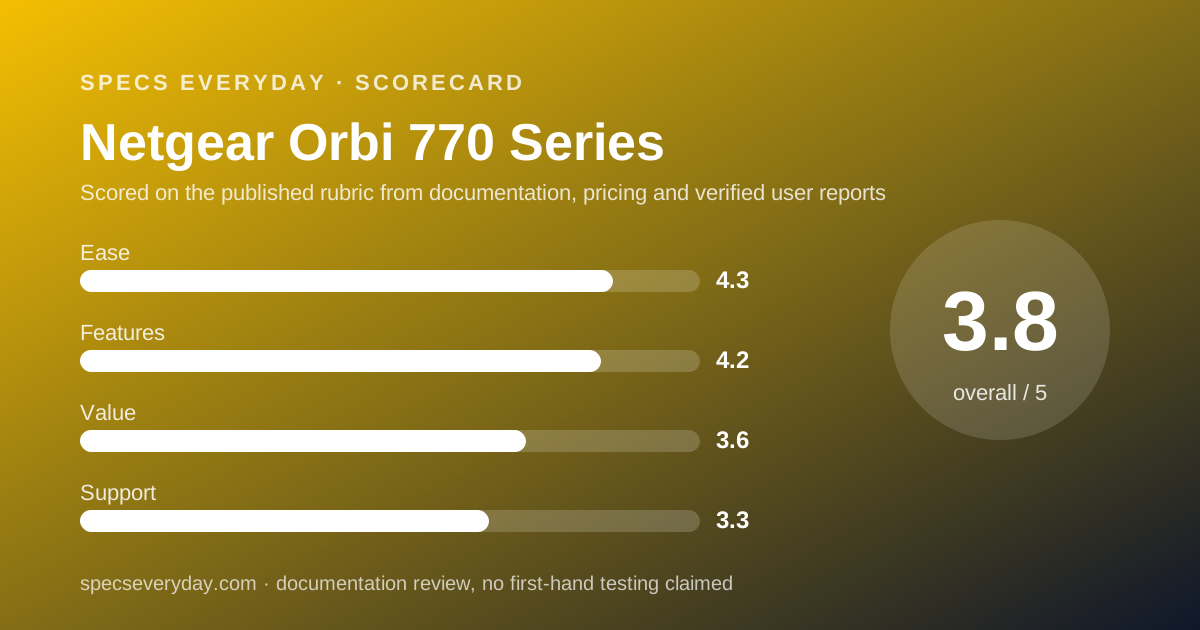
Ease of use: what the 4.3 is built from
Netgear documents app-based installation and management through the Orbi app, three pre-separated networks and automatic firmware updates. The router-plus-satellite layout also removes a decision: the unit with the WAN port is the router, full stop.
The score sits a little below the eero Pro 7 because Netgear's pages do not emphasize one-tap simplicity the way eero's do, and because Armor prompts live inside the same app. It sits slightly above the Deco BE63 because there are fewer advanced screens to navigate.
Features: what the 4.2 is built from
The Orbi 770's defining feature is the dedicated backhaul band. In a tri-band mesh with a reserved band, satellite-to-router traffic does not compete with phones and TVs for airtime, which matters when nodes are linked wirelessly. Netgear also lists a 2.5 Gbps wired backhaul option.
Multi-gig everywhere is the second strength: 2.5 Gbps on the WAN, three LAN ports on the router and two LAN ports on each satellite. A quad-core 1.5 GHz processor is stated, which neither eero nor TP-Link publishes for their comparable units.
The gaps are a 100-device ceiling, no port above 2.5 Gbps, no published per-band rates or stream counts, no Thread or Matter radio, and a 6 GHz band footnoted as limited to indoor range. Netgear's page also does not mention 320 MHz channels, MLO or 4K QAM by name.
Value: what the 3.6 is built from
At $699.99 for a 3-pack, the Orbi 770 asks a premium of about $300 over a Deco BE63 3-pack at TP-Link's October 16, 2026 store price. What that buys is the dedicated backhaul band, a larger stated coverage area and a router-satellite design.
What it does not buy is more devices, faster ports, a longer published warranty or free security software. For a household that can run one Ethernet cable between nodes, most of the backhaul advantage disappears and the price gap is hard to justify.
The score reflects a product that is fairly priced for its niche, large wireless-only homes, and expensive for everyone else.
Support: what the 3.3 is built from
Netgear's product page states a limited warranty valid only if the product is purchased from a Netgear authorized reseller and registered at my.netgear.com. It says technical support is available at no charge for a specified period and that software updates are provided for a period described on Netgear's end-of-service page, without stating either period.
Netgear's consumer warranty page confirms registration is required and says standard length is set by the region of purchase. The duration table itself is an image, and on October 16, 2026 we could not read it with the tools available to us. We therefore do not state a number of years, and we suggest buyers read that table before purchase.
The low score reflects published terms that are conditional and partly unreadable, not any report of poor service. Refurbished units, Netgear notes, carry a 90-day warranty.
What verified owners report
Netgear's product page hosts customer reviews. We did not read enough of them on October 16, 2026 to summarize fairly, and the page did not show an aggregate count we could cite alongside a rating. One featured review describes a multi-gig fiber plan paired with the system, which is anecdotal and selected by Netgear.
We do not reproduce quotes. Treat owner reviews on a manufacturer page as marketing-adjacent until a larger independent sample is available.
What we can say from the documentation is that the router-plus-satellite design makes placement decisions simpler than with interchangeable units: the router goes by the modem, the satellites go roughly halfway to the dead zones, and Netgear's 2,500 sq. ft. per-unit figure gives a rough spacing guide. When an independent owner sample with a date is available, we will add it here.
Limits stated by Netgear
Netgear's footnotes narrow the headline claims in useful ways.
- The 11 Gbps figure is derived from the 802.11be specification; actual throughput and coverage will be lower and vary by country regulation
- The 6 GHz band is limited to indoor range
- Coverage is stated as up to 8,000 sq. ft. for the 3-pack, with 2,500 sq. ft. per unit on the tech-spec tab and 2,750 per satellite in the pack selector
- Up to 100 concurrent devices
- Warranty valid only with purchase from an authorized reseller and product registration
- Armor trial length, free support period and software update period are not stated on the product page
Alternatives from the spec sheets
Choose the TP-Link Deco BE63 if you can run an Ethernet cable between nodes or your home is under 5,000 sq. ft. Its 3-pack was $303 cheaper on October 16, 2026, it lists 200 devices and it has four 2.5 GbE ports per unit. Otherwise choose the Orbi 770 if the backhaul must be wireless across a large house.
Choose the Amazon eero Pro 7 if your plan exceeds 2.5 Gbps, you want a Thread and Matter hub, or you want a 3-year warranty stated in plain text. Otherwise choose the Orbi 770 if you want a dedicated backhaul band and satellites with two multi-gig ports.
Choose an ASUS ZenWiFi BT8 if you want published 3x3 per-band rates, WireGuard VPN and a 3-year warranty at a similar 2-pack price. Otherwise choose the Orbi 770 if the stated coverage per pack is the deciding factor.
All four reviews are listed on the Routers and mesh topic page.
Bottom line
The Orbi 770 Series is a specialist. For a large home where satellites must link wirelessly, the dedicated backhaul band, 2.5 GbE on every node and 8,000 sq. ft. of stated coverage from a 3-pack make it a reasonable $699.99.
For a typical two- or three-bedroom home, the 100-device ceiling, unreadable warranty term, $99.99-a-year Armor and the price gap to the Deco BE63 argue against it.
Every figure above was read from netgear.com on October 16, 2026. Prices and terms change; confirm on the official page before buying. Our grading approach is on the about page.
Buy it if
- Your home is 5,000 sq. ft. or larger and the mesh must work wirelessly between floors
- You want a router-and-satellite design rather than identical interchangeable units
- Every node needs multi-gig Ethernet, since each satellite has two 2.5 Gbps LAN ports
- You will register the product and buy from an authorized reseller, which Netgear requires for warranty
Skip it if
- You have more than 100 connected devices, which is Netgear's stated ceiling
- Your plan is faster than 2.5 Gbps, because no port exceeds that
- You want security filtering without a $99.99-a-year subscription
Frequently asked
How much does the Netgear Orbi 770 Series cost?
On netgear.com, checked October 16, 2026, the Orbi 770 3-pack (RBE773, one router plus two satellites) is $699.99, the 2-pack (RBE772) is $549.99 and an add-on satellite (RBE770) is $299.99. All prices are in US dollars.
How many square feet does the Orbi 770 cover?
Netgear lists up to 8,000 sq. ft. for the 3-pack and 5,500 sq. ft. for the 2-pack. The tech-spec tab lists 2,500 sq. ft. for the router and for each satellite, while the pack selector lists 2,750 sq. ft. per satellite; the page is inconsistent.
Does the Orbi 770 have a 10 Gbps port?
No. Every port on the router and satellites is rated 10/100/1000/2500 Mbps, per the tech specs read October 16, 2026. The router has one 2.5 Gbps WAN and three 2.5 Gbps LAN ports; each satellite has two 2.5 Gbps LAN ports.
What is the Orbi 770 warranty?
Netgear states a limited warranty valid only if purchased from an authorized reseller and registered at my.netgear.com. The duration table on Netgear's consumer warranty page is an image we could not read on October 16, 2026, so we do not state a number of years.
Is Netgear Armor included with the Orbi 770?
A trial is included; Netgear does not state its length on the product page. After the trial, the Armor page lists $99.99 per year for Armor and $149.99 per year for Armor Plus, as of October 16, 2026. The system works without Armor.
How many devices can the Orbi 770 handle?
Netgear lists up to 100 concurrent devices for the Orbi 770 Series as of October 2026. That is half the 200 devices TP-Link lists for the Deco BE63 and below the 200+ eero lists for the eero Pro 7.
Sources
- Netgear Orbi 770 Series (RBE773) product page and tech specs - checked October 16, 2026
- Netgear Armor pricing page - checked October 16, 2026
- Netgear Home Networking limited hardware warranty - checked October 16, 2026
Update history
- October 16, 2026 - First published from Netgear product, Armor and consumer warranty pages read October 16, 2026. Warranty duration table could not be read (image).
Visit Netgear Orbi 770 Series
We have no affiliate relationship with this vendor. Link goes to the official site.