 Specs

Amazon eero Pro 7
Tri-band Wi-Fi 7 mesh with two 5 GbE ports, a built-in smart home hub and a 3-year warranty, read from the spec sheet
Scored on the published rubric, from documentation, pricing and verified user reports.
Best for: Households on a 1 to 5 Gbps internet plan that want a mesh system set up from a phone in minutes, with Thread and Matter built in, and do not need per-band speed figures or 10 GbE.
Verdict
The eero Pro 7 is the mesh system to buy when the goal is to stop thinking about the router. This is a documentation review: every figure below comes from eero.com as read on October 16, 2026, not from lab testing. On paper the unit is a tri-band Wi-Fi 7 node with two auto-sensing 5 GbE ports, wireless speeds eero lists at up to 3.9 Gbps, 2,000 sq. ft. of coverage per unit and support for 200+ devices. It also ships with a Thread, Zigbee and Matter controller radio set, and it carries a 3-year warranty, which is the longest in this group. The trade-offs are also on the spec sheet. eero does not publish per-band link rates, stream counts or RAM, so it is impossible to compare raw radio numbers against TP-Link or ASUS. Advanced security, ad blocking and content filters sit behind the eero Plus subscription at $9.99 a month or $99.99 a year. And at $549.99 for a 2-pack it costs noticeably more than a Deco BE63 2-pack on TP-Link's store. If simplicity and the long warranty matter more than tweakable settings, it is a sound pick.
Visit Amazon eero Pro 7
We have no affiliate relationship with this vendor. Link goes to the official site.
Where it is strong
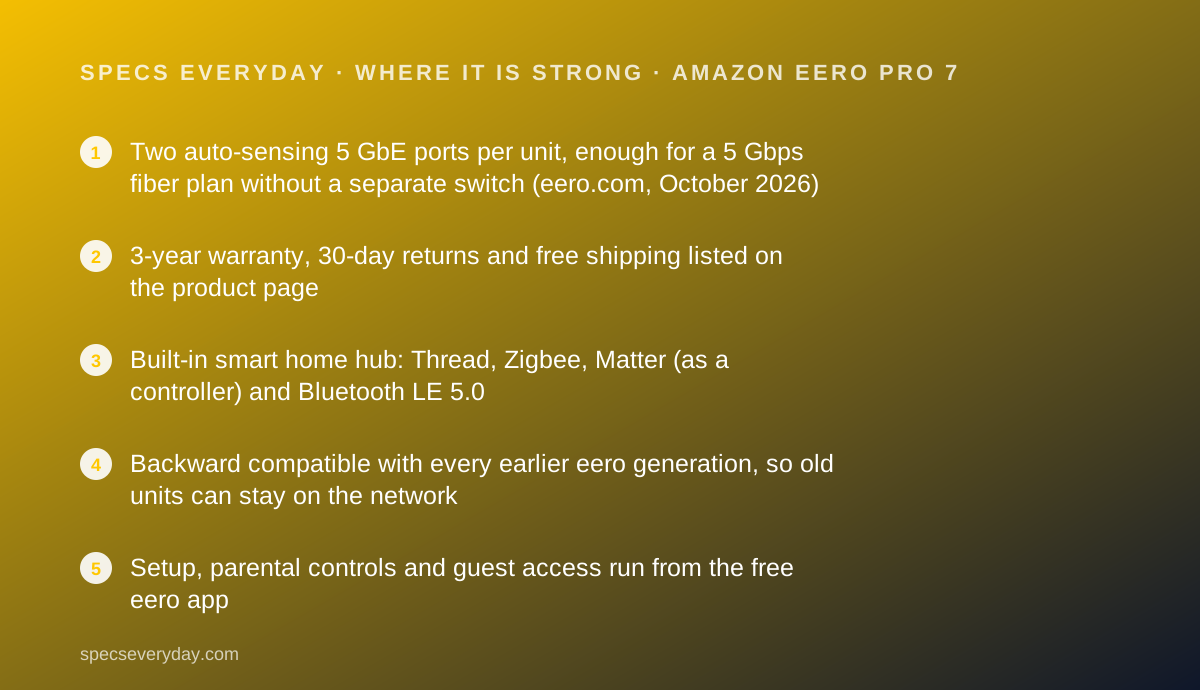
- Two auto-sensing 5 GbE ports per unit, enough for a 5 Gbps fiber plan without a separate switch (eero.com, October 2026)
- 3-year warranty, 30-day returns and free shipping listed on the product page
- Built-in smart home hub: Thread, Zigbee, Matter (as a controller) and Bluetooth LE 5.0
- Backward compatible with every earlier eero generation, so old units can stay on the network
- Setup, parental controls and guest access run from the free eero app
Where it falls short
- eero does not publish per-band Mbps, stream counts, processor speed or RAM on the product page
- Advanced security, ad blocking, Malwarebytes, 1Password and the Guardian VPN require eero Plus ($9.99/month or $99.99/year)
- 2-pack list price of $549.99 is the highest in this group as of October 16, 2026
- Coverage is listed at 2,000 sq. ft. per unit, below the 2,500 sq. ft. eero lists for the eero Max 7
At a glance
| Wi-Fi standard | Wi-Fi 7 (802.11be), tri-band |
|---|---|
| Stated wireless speed | Up to 3.9 Gbps (eero.com, Oct 2026) |
| Ethernet ports | 2 x auto-sensing 5 GbE per unit |
| Coverage per unit | Up to 2,000 sq. ft. |
| Device support | 200+ devices per unit |
| Smart home radios | Thread, Zigbee, Matter controller, Bluetooth LE 5.0 |
| Platform | Qualcomm Dragonwing N7 |
| Warranty | 3 years |
| Price (USD) | $299.99 / $549.99 / $799.99 for 1 / 2 / 3 units |
| Pricing note | 1-pack $299.99, 2-pack $549.99, 3-pack $799.99 (eero.com, checked October 16, 2026); eero Plus optional at $9.99/month or $99.99/year |
What the eero Pro 7 actually is
The eero Pro 7 is Amazon's mid-tier Wi-Fi 7 mesh node. It sits between the dual-band eero 7 and the flagship eero Max 7 in eero's own lineup, and eero sells it as a 1-pack, 2-pack or 3-pack of identical units.
Each unit is a tri-band Wi-Fi 7 radio on the Qualcomm Dragonwing N7 platform, per the product page read on October 16, 2026. Any unit can be the gateway; the rest become wireless or wired satellites.
The product page states wireless speeds up to 3.9 Gbps, two auto-sensing 5 GbE ports, 2,000 sq. ft. of coverage and support for 200+ devices per unit. It does not break the speed figure down by band.
This review is built from eero's published documentation, not from running the hardware. Where eero does not publish a number, this page says so rather than guessing. Our grading approach is explained on the editorial policy page.
Who the eero Pro 7 is best for
The eero Pro 7 fits a specific kind of household, and the spec sheet makes that clear.
- Homes on a 1 to 5 Gbps fiber or cable plan: the 5 GbE WAN port can carry the whole plan, which a 2.5 GbE port cannot
- People who want app-only setup: eero's pitch is set up, share, control, relax, all from the phone
- Existing eero owners who want to upgrade the gateway and keep older units as satellites
- Smart home households running Thread, Zigbee or Matter devices with Alexa
- Small offices that eero also markets this unit to, where a 3-year warranty is useful
- Anyone who values warranty length: 3 years is the longest among the four systems in our Routers and mesh coverage
Who should skip it
Skip the eero Pro 7 if you choose routers by radio numbers. eero does not list per-band Mbps, stream counts or RAM, so a spreadsheet comparison against TP-Link or ASUS is not possible from official pages.
Skip it too if you want security filtering without a subscription, since eero puts advanced security and ad blocking behind eero Plus. And skip it if a single Wi-Fi 7 router already covers your home; a 2,000 sq. ft. apartment does not need a mesh.
What is included free and what sits behind eero Plus
The free layer is the eero app with parental controls, guest networking and automatic updates, as listed on the product page in October 2026. Smart home hub functions (Thread, Zigbee, Matter controller, Bluetooth LE 5.0) are also included with the hardware.
eero Plus is the paid layer. The eero Plus page, read October 16, 2026, lists it at $9.99 per month with a one-month free trial, or $99.99 per year with a two-month free trial. It auto-renews until canceled.
The subscription bundles advanced security, ad blocking, content filters, Malwarebytes, 1Password, a VPN by Guardian and identity protection with $1 million USD in identity theft insurance (insurance terms set by Malwarebytes). eero notes that the older eero Secure plan is no longer sold through eero.
In plain terms: the router works fully without paying, but network-level ad blocking and threat filtering cost about $100 a year on top of the hardware.
How the pricing is structured
eero prices the Pro 7 by pack size on eero.com, with no bundles or tiers on the hardware itself. As of October 16, 2026, the 1-pack is $299.99, the 2-pack $549.99 and the 3-pack $799.99.
The arithmetic is ours: the 2-pack saves $49.99 against two singles, and the 3-pack saves $99.98 against three singles. Per unit, the 3-pack works out to about $266.66.
For comparison, eero lists the eero Max 7 from $599.99 to $1,699.99 on the same page. The Pro 7 is therefore the step most households will land on if they want Wi-Fi 7 from eero without paying flagship money.
All prices are US dollars from the US store. The page lists free shipping and 30-day returns. Any commission arrangement, if one ever exists, would be disclosed on the disclosure page and never changes a grade.
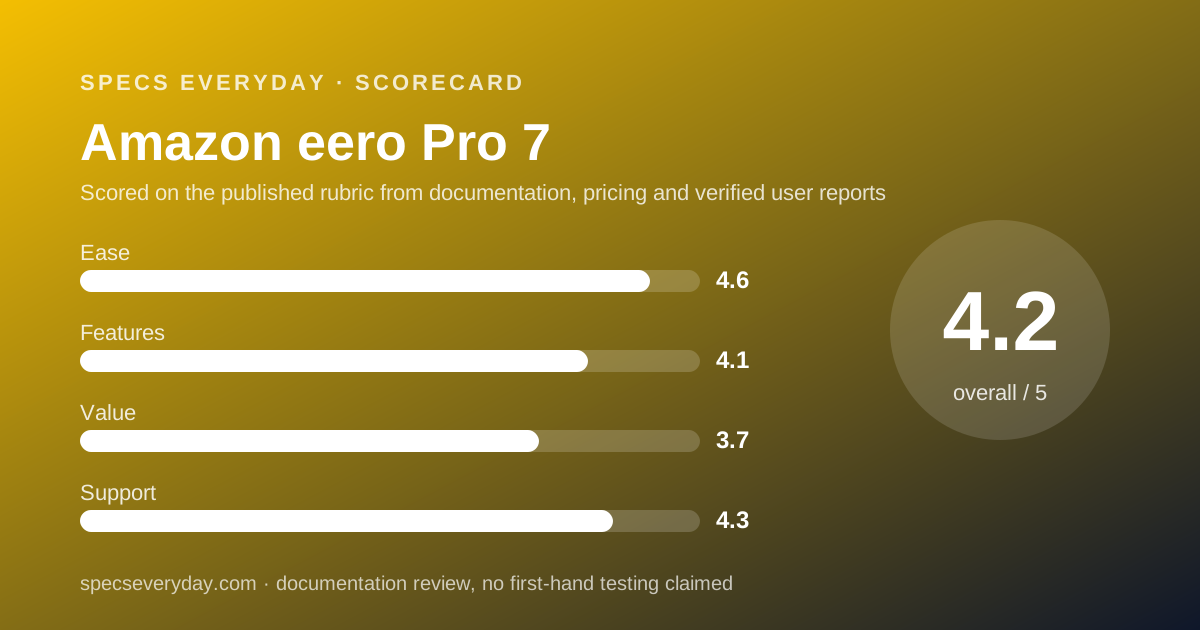
Ease of use: what the 4.6 is built from
eero's documentation leans almost entirely on simplicity, and the published feature set supports a high ease score. Setup, sharing, device control and updates are all app-driven, and eero's TrueMesh, TrueRoam and TrueChannel software is described as proactively keeping devices on the best connection.
The auto-sensing ports also reduce setup friction. Either 5 GbE port can be the WAN side, so there is no wrong jack for the modem cable.
The score is not a 5 because the same simplicity removes control. Per-band settings, channel width choices and advanced routing options are not listed anywhere on the product page, and users who want them will not find them in the eero app.
Features: what the 4.1 is built from
The headline features are Wi-Fi 7 with Multi-Link Operation, two 5 GbE ports, a smart home hub and full backward compatibility with older eero units. The Wi-Fi Alliance describes MLO as load balancing traffic across links for higher throughput and reliability, which is the feature that matters most for mesh backhaul.
The stated wireless ceiling is 3.9 Gbps. That is a single figure for the whole unit, and eero does not say how it is split across 2.4 GHz, 5 GHz and 6 GHz. It also does not state 320 MHz channel support or 4K QAM explicitly, though both are part of the Wi-Fi 7 feature set the Alliance lists.
The score loses points for the missing detail and for the absence of USB, 10 GbE or a dedicated backhaul band in the documentation. The smart home hub, which competitors in the Routers and mesh group do not match, earns most of the credit.
Value: what the 3.7 is built from
Value is where the eero Pro 7 is weakest on paper. At $549.99 for two units, it is priced above the 2-pack figures TP-Link lists for the Deco BE63 on its own store in October 2026, and in the same range as a Netgear Orbi 770 2-pack at $549.99.
What the buyer gets for that money is the 5 GbE ports, the 3-year warranty and the smart home radios. What the buyer does not get is the per-band transparency, the extra Ethernet ports or the free advanced security that rivals list.
The optional $99.99 a year for eero Plus adds up: over the 3-year warranty period that is roughly $300 on top of a 2-pack, by our arithmetic. Households that will never subscribe should not count the subscription against the hardware.
Support: what the 4.3 is built from
The product page lists a 3-year warranty, free support, free shipping and 30-day returns as of October 16, 2026. That warranty term is one year longer than the 2 years TP-Link lists for Deco purchases on or after September 1, 2023, and eero does not condition it on product registration the way Netgear's warranty page does.
eero does not publish on the product page how long free phone or chat support runs or what its firmware update horizon is. The score reflects a strong warranty with limited published detail on support channels.
What verified owners report
This review does not draw on owner reviews from the eero store, because eero.com did not expose a readable review feed in the version of the page we read on October 16, 2026. Rather than quote star ratings from third-party retailers, which mix multiple eero generations, we leave this section to published facts.
If you want a sense of real-world experience, the most useful signal is eero's own statement that the Pro 7 delivers twice the speed of the dual-band eero 7 and connects many more devices. That is a manufacturer comparison between its own products, not an independent measurement.
Limits stated by eero
eero's documentation sets a few boundaries worth reading before buying.
- Coverage is listed at 2,000 sq. ft. per unit; the eero Max 7 is listed at 2,500 sq. ft.
- Wireless speed is stated as up to 3.9 Gbps, with no per-band breakdown published
- Matter support is as a controller only, per the FAQ on the product page
- Advanced security and management tools are listed as available with eero Plus, not included
- eero Secure is no longer available for purchase through eero or for new free trials
Alternatives from the spec sheets
Choose a TP-Link Deco BE63 if you want four 2.5 GbE ports per unit, published per-band speeds and a lower 2-pack price. Otherwise choose the eero Pro 7 if a single 5 GbE WAN port and the smart home hub matter more.
Choose a Netgear Orbi 770 Series if you want a dedicated backhaul band and 8,000 sq. ft. of stated coverage from a 3-pack. Otherwise choose the eero Pro 7 if you prefer a 3-year warranty that does not depend on registration.
Choose an ASUS ZenWiFi BT8 if you want WireGuard VPN, 1 GB of RAM listed openly and a 3-year warranty with the highest stated per-band speeds. Otherwise choose the eero Pro 7 if you want the simplest app and Thread built in.
Full reviews of those three systems are published in order on the Routers and mesh topic page.
Bottom line
The eero Pro 7 is the mesh system for people who want Wi-Fi 7, 5 GbE and a smart home hub without ever opening an advanced settings page. The 3-year warranty is a real advantage over TP-Link's 2 years.
Its weaknesses are also clear from eero's own pages: the highest 2-pack price in this group, no published per-band figures and a subscription for security features that rivals bundle. Buy it for the simplicity and warranty; look elsewhere if you want numbers and knobs.
Every figure above was read from eero.com on October 16, 2026. Prices and terms change; check the official page before paying. See how we grade on the about page.
Buy it if
- Your internet plan is between 1 and 5 Gbps and you want a port that can carry it without buying a switch
- You already own eero units and want to keep them as satellites on the same network
- You run Thread or Matter smart home gear and would rather not add a separate hub
- A 3-year warranty matters more to you than configurable radio settings
Skip it if
- You compare routers by per-band Mbps and stream counts, because eero does not publish them
- You refuse to pay a subscription for security filtering and ad blocking
- Your house is under 2,000 sq. ft. and a single Wi-Fi 7 router would do the job for less
Frequently asked
How much does the eero Pro 7 cost in October 2026?
On eero.com, checked October 16, 2026, the eero Pro 7 is listed at $299.99 for a 1-pack, $549.99 for a 2-pack and $799.99 for a 3-pack. Prices are in US dollars and exclude any eero Plus subscription.
Is eero Plus required to use the eero Pro 7?
No. The product page lists a free eero app with parental controls. eero Plus, at $9.99 a month or $99.99 a year, adds advanced security, ad blocking, content filters, Malwarebytes, 1Password and a VPN by Guardian, per eero.com in October 2026.
How many square feet does the eero Pro 7 cover?
eero lists up to 2,000 sq. ft. per unit, so a 2-pack is marketed around 4,000 sq. ft. and a 3-pack around 6,000 sq. ft. Those are manufacturer figures as of October 2026; walls, floors and placement change the real result.
Does the eero Pro 7 have 10 GbE ports?
No. The eero Pro 7 has two auto-sensing 5 GbE ports per unit. eero's own comparison table reserves the two 10 GbE plus two 2.5 GbE port layout for the eero Max 7, as read on October 16, 2026.
What is the eero Pro 7 warranty?
The eero.com product page lists a 3-year warranty, 30-day returns, free shipping and free support as of October 2026. That is one year longer than the 2-year term TP-Link lists for its Deco family in the US.
Does the eero Pro 7 work with older eero devices?
Yes. eero states the Pro 7 is backward compatible with all previous generations of eero and with eero Built-in on select Amazon Echo devices, so an older eero can remain as a node on the new network.
Sources
- eero Pro 7 product page (specs, pack prices, warranty) - checked October 16, 2026
- eero Plus subscription page (pricing and features) - checked October 16, 2026
- Wi-Fi Alliance, Wi-Fi CERTIFIED 7 overview - checked October 16, 2026
Update history
- October 16, 2026 - First published from eero.com product and eero Plus pages read October 16, 2026.
Visit Amazon eero Pro 7
We have no affiliate relationship with this vendor. Link goes to the official site.