 Specs
Sony WH-1000XM6 vs Bose QuietComfort Ultra Headphones
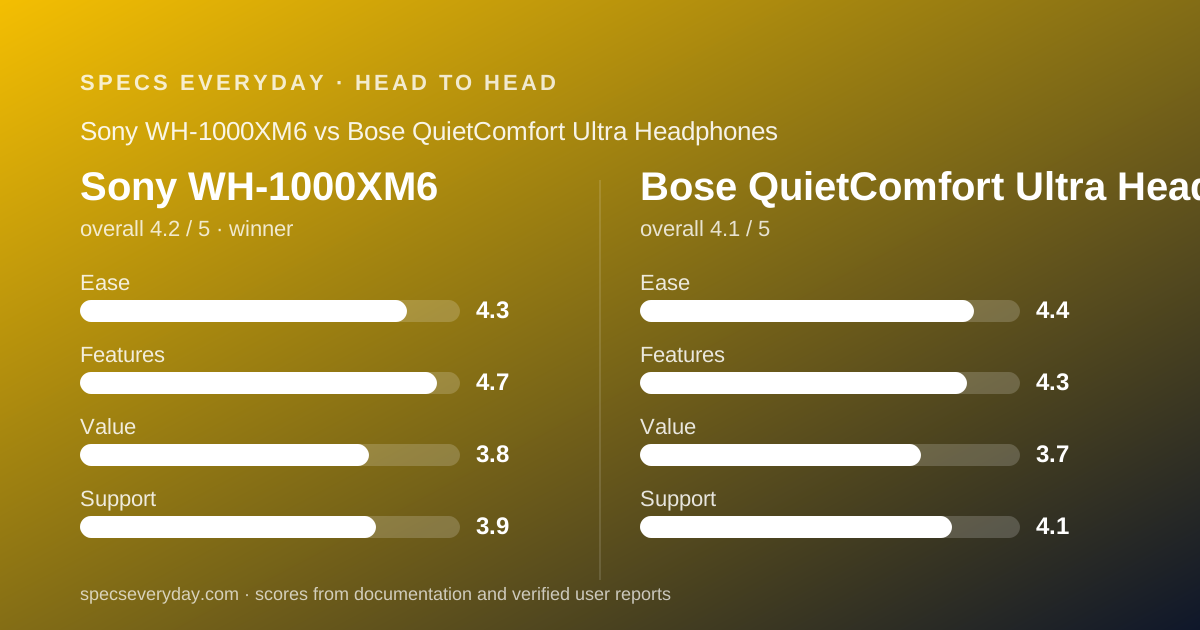
Sony WH-1000XM6 ($459.99) and Bose QuietComfort Ultra Headphones (2nd Gen) ($449.00) are the two default premium noise-cancelling headphones of October 2026. Read side by side from the official Sony and Bose pages on October 16, 2026, Sony wins on documentation: four codecs including LDAC and LC3, multipoint listed as Yes, 30 and 40 hour battery figures without a conflicting footnote, folding cups and 24 hours of talk time. Bose wins on three everyday lines: a lighter published weight, a 15-minute charge for 3 hours with no special adapter, and a one-year warranty stated on the product page. This is a documentation comparison, not a listening test, and neither sheet can tell you which cancels more noise.
 4.2Sony WH-1000XM6
 4.1Bose QuietComfort Ultra Headphones (2nd Gen)
Specification by specification
| Spec | Sony WH-1000XM6 | Bose QuietComfort Ultra Headphones (2nd Gen) |
|---|---|---|
| List price (October 16, 2026) | $459.99 | $449.00 |
| Battery, ANC on | Max. 30 hrs (40 hrs ANC off) | Up to 30 hrs headline; footnote 24 hrs |
| Battery with spatial audio | Not published | 23 hrs headline; footnote 18 hrs |
| Talk time | Max. 24 hrs ANC on | Not published |
| Quick charge | 3 min for 3 hrs, optional USB-PD adapter, headphones off | 15 min for 3 hrs |
| Full charge | Approx. 3.5 hrs | 3 hrs |
| Bluetooth | 5.3 | 5.4 |
| Codecs | SBC, AAC, LDAC, LC3 | Not listed; aptX Adaptive for Snapdragon Sound gaming only |
| Multipoint | Yes | Not stated; cycle through paired devices |
| Weight | Approx. 8.96 oz (about 254 g) | 0.583 lb (about 264 g) |
| Wired audio | 3.94 ft detachable cable | USB-C lossless 16-bit 44.1/48 kHz; 3.5 mm to 2.5 mm cable |
| Microphones | 12 | Not published |
| Folding | Yes | Not stated |
| Warranty | Not readable on pages rendered | 1-year Bose limited warranty |
The short answer
Two sentences settle most buyers. Then the rest of the page shows the evidence.
- Sony WH-1000XM6 is best for Android users, two-device workers and anyone who wants the longest documented feature list: LDAC, LC3, multipoint Yes, 30/40 hours, folding cups, 24-hour talk time
- Bose QuietComfort Ultra Headphones (2nd Gen) is best for weight-first buyers, people who top up rather than charge overnight, laptop listeners who want USB-C lossless, and anyone who wants the warranty on the product page
- Winner on documentation: Sony, by a margin that comes from what Bose leaves unsaid rather than from any Bose figure being worse
- What neither page can settle: which cancels more cabin noise. No decibel figure is published by either maker, and this page does not pretend to know
How this comparison was built
Every figure comes from the Sony US store page and Sony support specification page, and from the bose.com product page for the 2nd Gen model, all read October 16, 2026. We did not wear or measure either pair. Full breakdowns are in the Sony WH-1000XM6 review and the Bose QuietComfort Ultra Headphones review.
We compare the original Bose QuietComfort Ultra Headphones with the 2nd Gen because the original no longer appeared on Bose's storefront on the day we read it. Our method page explains why a missing line counts against a product in a documentation comparison.
Battery: Sony's sheet is clearer, and the Bose footnote lowers the Bose headline
Sony lists maximum 30 hours of music with noise cancelling on and 40 hours with it off, plus 24 and 28 hours for calls. The test condition is AAC with DSEE Extreme and EQ off. There is one set of numbers and no contradiction.
Bose's headline is up to 30 hours, or 23 with Immersive Audio. The footnote on the same page lists 24 hours off and 18 on, from April 2025 testing of a product named without the 2nd Gen suffix. Either the footnote is stale or the headline is optimistic; the page does not say which.
If you take both headlines at face value, the two tie at 30. If you take Bose's footnote, Sony leads by six hours. Sony also publishes the ANC-off and talk figures that Bose omits. On documentation, Sony wins this line.
In a normal week neither figure is limiting. A two-hour daily commute uses 10 hours. The difference matters on long-haul travel and on how often you think about charging.
Charging: Bose's claim is simpler; Sony's is faster on paper but needs an adapter
Bose lists 15 minutes of charging for 3 hours of playback and a 3-hour full charge. No adapter type is specified, and none is included.
Sony lists 3 minutes for up to 3 hours, which looks five times faster. The footnote adds two conditions: the headphones must be switched off, and you need an optional USB-PD compatible AC adapter that is not in the box. A full charge takes approximately 3.5 hours.
For a buyer who already owns a USB-PD laptop charger, Sony's claim is the better one. For a buyer who plugs into whatever is nearby, Bose's claim is the one that will hold. On documentation we call this line for Bose, because its claim carries no hidden requirement.
Bluetooth and codecs: Bose has the newer version, Sony has the useful list
Bose lists Bluetooth 5.4; Sony lists 5.3. In everyday use the version number changes little, but 5.4 is the more recent specification and Bose gets the point.
Codecs are a different story. Sony's support page lists SBC, AAC, LDAC and LC3, with LDAC at up to 990 kbps and 96 kHz sampling when Priority on Sound Quality is set in the app. The profile list includes the LE Audio set, and the Auracast mark appears on the store page.
Bose's page lists profiles, not codecs: A2DP, HFP, AVRCP and Bluetooth LE. aptX Adaptive is mentioned once, in a gaming FAQ for Snapdragon Sound sources. SBC and AAC are implied by the profiles but not named.
For an iPhone owner both pairs run AAC and the gap closes. For an Android owner Sony offers LDAC and Bose offers an unlisted baseline. Sony wins this line clearly, and the AirPods Max 2 sheet shows a third approach: no codec list at all, with lossless reserved for the USB-C cable.
Multipoint: Sony says Yes, Bose says cycle through paired devices
This is the line that decides the comparison for hybrid workers. Sony's specification page lists Multipoint Connection as Yes, and the store FAQ says the headphones can pair with more than one device at a time, with the standard interoperability caveat.
Bose's page never uses the word multipoint. It says you can cycle through paired devices, which describes switching, not simultaneous connection. Bose may well support it in practice, but the page does not commit to it.
We grade what is written. Sony wins this line, and it is the clearest documentation gap on the Bose page.
Noise cancelling: both describe the mechanism, neither publishes a result
Sony describes 12 microphones, the HD Noise Canceling Processor QN3 that it says is 7x faster than the QN1, and an Adaptive NC Optimizer that adjusts to noise, air pressure and wearing style. Bose describes next-generation ActiveSense that smooths spikes in noise, plus Aware and Quiet modes.
Neither page publishes a decibel reduction figure or cites a measurement standard. Apple is the only maker on this shelf to cite one, IEC 60268-24, and only relative to its own earlier model.
So this line is a draw by documentation. Anyone who tells you from a spec sheet which pair is quieter on a plane is guessing. The Sennheiser MOMENTUM 4 Wireless page is the same: four microphones, hybrid ANC, no figure.
Weight and comfort: Bose publishes the lower figure, within about 10 g of Sony
Bose lists 0.583 lb for the headphone, about 264 g by our conversion. Sony lists approx. 8.96 oz, about 254 g by our conversion. Our conversions put Sony slightly lighter, but Sony's figure is rounded to two decimals of an ounce and Bose's to three of a pound, so the honest reading is that they are within measurement noise of each other.
Bose also publishes the whole-system weight with case, 1.061 lb, and the headphone dimensions. Sony publishes neither a case weight nor dimensions on the pages we read.
Sony's earcups fold; Bose's page does not state folding. For a backpack, Sony's case will be the smaller shape. We call the weight line a tie and give Sony the portability line for the documented fold.
Wired listening: Bose documents USB-C lossless, Sony documents a cable
Bose lists wired lossless over USB-C at 16-bit, 44.1 or 48 kHz, plus a 3.5 mm to 2.5 mm analogue cable in the box. Sony lists a single-sided detachable cable of approx. 3.94 ft and makes no USB audio claim on the pages we read.
For a desk listener on a laptop, Bose's documented digital path is the more useful line. Bose wins it.
Pricing and what is in the box: $10 apart, different omissions
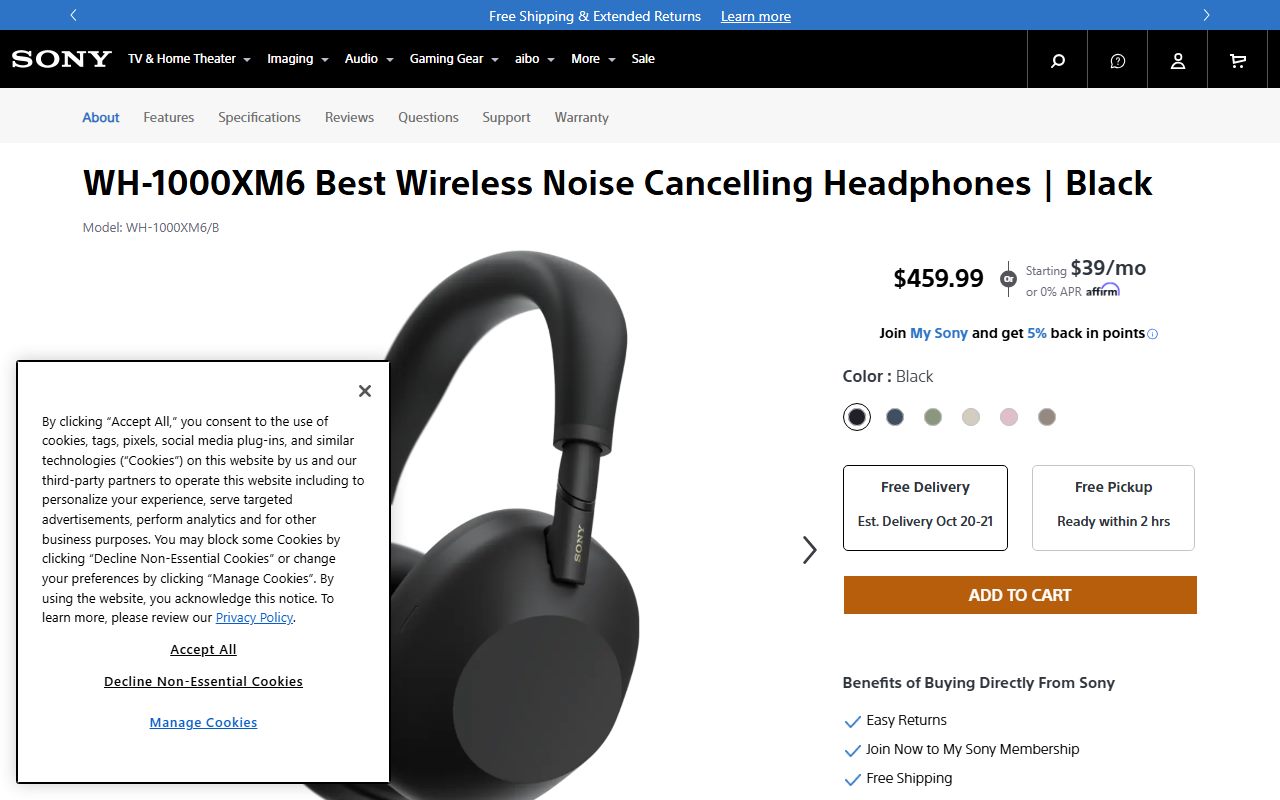
Sony is $459.99 in Black, Midnight Blue, Platinum Silver, Sand Pink and Sandstone. Bose is $449.00; the page named only Cherry Chocolate in text, with other swatches unlabeled. The $10.99 gap is small enough to ignore.
Sony's box: carrying case, connection cable, USB cable, warranty card, reference guide. No USB-PD adapter and no USB-C to C cable, which the quick-charge headline depends on. Bose's box: carry case, 3.5 mm to 2.5 mm cable, 39-inch USB-C to C cable, safety sheet. No power adapter.
Bose sells BoseCare at $59.95 for years two and three and Accident Protection at $99.95 for three years. Sony offers Affirm financing from $39 a month, a trade-in and 5 percent back in My Sony points. Neither changes the list price. Our buying guides place both against the cheaper Sennheiser.
Warranty and support: Bose states one year on the page; Sony's term did not render
Bose's product page states a one-year Bose limited warranty and prices its extensions. Sony's store page has a Warranty tab whose contents did not render in the pages we read on October 16, 2026, and the Sony support warranty article did not render either. A warranty card is listed in Sony's box.
We do not print a Sony term we could not read. Bose wins this line on documentation, which is exactly the kind of result a documentation comparison should surface. Our about page explains the policy.
Choose Sony WH-1000XM6 if
Three or more of these describe you.
- You use an Android phone and want LDAC at up to 990 kbps, or want LC3 ready for LE Audio
- You keep a laptop and a phone connected together and want multipoint listed as Yes
- You want one clear battery sheet: 30 hours ANC on, 40 off, 24 hours of calls, no conflicting footnote
- You pack headphones in a bag and want documented folding earcups
- You already own a USB-PD charger and will use the 3-minute quick charge
Choose Bose QuietComfort Ultra Headphones (2nd Gen) if
Three or more of these describe you.
- You want the lower published weight and the whole-system weight stated with the case
- You top up for 15 minutes before leaving and do not want to buy an adapter to make the claim true
- You listen wired from a laptop and want USB-C lossless at 16-bit, 44.1 or 48 kHz documented
- You want the warranty term on the product page and extension prices in the open
- You use an iPhone and the codec gap does not apply to you
Frequently asked
Which has better battery life, Sony WH-1000XM6 or Bose QuietComfort Ultra Headphones? On headlines they tie at 30 hours with ANC on. Sony also lists 40 hours ANC off and 24 hours of talk. Bose's own footnote lists 24 hours, so the cautious reading gives Sony a six-hour lead. Read October 16, 2026.
Which is lighter? Bose lists 0.583 lb (about 264 g); Sony lists approx. 8.96 oz (about 254 g). By our conversions they are within 10 g, which is inside the rounding of the published figures. Treat them as equal on paper and decide by fit.
Does the Bose QuietComfort Ultra Headphones (2nd Gen) have multipoint like the Sony? Sony's page says Yes. Bose's page says you can cycle through paired devices and never uses the word multipoint. If simultaneous connection to two devices matters, Sony is the one that documents it.
Which is cheaper? Bose at $449.00 against Sony at $459.99, a $10.99 gap on October 16, 2026. Sony's quick-charge headline needs a USB-PD adapter that is not included, which can close the gap if you do not already own one.
Can I switch from Sony to Bose and keep LDAC? No. LDAC is not listed on the Bose page. On an iPhone both run AAC, so nothing is lost; on Android you move from LDAC to the unlisted baseline codecs that A2DP implies. Our headphones topic page lists every sheet we have read with its codec line.
Bottom line
By the documents, Sony WH-1000XM6 is the more complete headphone: four codecs, multipoint in writing, a clean battery sheet, folding cups and 24-hour talk time. Bose QuietComfort Ultra Headphones (2nd Gen) answers with a lower weight, a simpler quick charge, USB-C lossless and a warranty you can read before paying.
Android and two-device users should buy Sony. iPhone users who top up in short bursts and care about weight should buy Bose, and will give up nothing they can hear. Figures are as of October 16, 2026. The Sennheiser MOMENTUM 4 Wireless and AirPods Max 2 reviews cover the other two flagships, and our disclosure page explains how links and updates are handled.
Frequently asked
Which has better battery life, Sony WH-1000XM6 or Bose QuietComfort Ultra Headphones?
On headlines they tie at 30 hours with ANC on. Sony also lists 40 hours ANC off and 24 hours of talk. Bose's own footnote lists 24 hours, so the cautious reading gives Sony a six-hour lead. Read October 16, 2026.
Which is lighter, Sony WH-1000XM6 or Bose QuietComfort Ultra Headphones?
Bose lists 0.583 lb (about 264 g); Sony lists approx. 8.96 oz (about 254 g). By our conversions they are within 10 g, inside the rounding of the published figures. Treat them as equal on paper and decide by fit.
Does the Bose QuietComfort Ultra Headphones (2nd Gen) have multipoint like the Sony?
Sony's specification page says Yes. Bose's page says you can cycle through paired devices and never uses the word multipoint. If simultaneous connection to two devices matters, Sony is the one that documents it.
Which is cheaper, Sony WH-1000XM6 or Bose QuietComfort Ultra Headphones?
Bose at $449.00 against Sony at $459.99, a $10.99 gap on October 16, 2026. Sony's quick-charge headline needs a USB-PD adapter that is not included, which can close the gap if you do not already own one.
Can I switch from Sony to Bose and keep LDAC?
No. LDAC is not listed on the Bose page. On an iPhone both pairs run AAC, so nothing changes; on Android you move from LDAC to the unlisted baseline codecs that A2DP implies.
Visit Sony WH-1000XM6
We have no affiliate relationship with this vendor. Link goes to the official site.
Visit Bose QuietComfort Ultra Headphones (2nd Gen)
We have no affiliate relationship with this vendor. Link goes to the official site.